
1. Preamble: The Engineered Crisis of Public Education
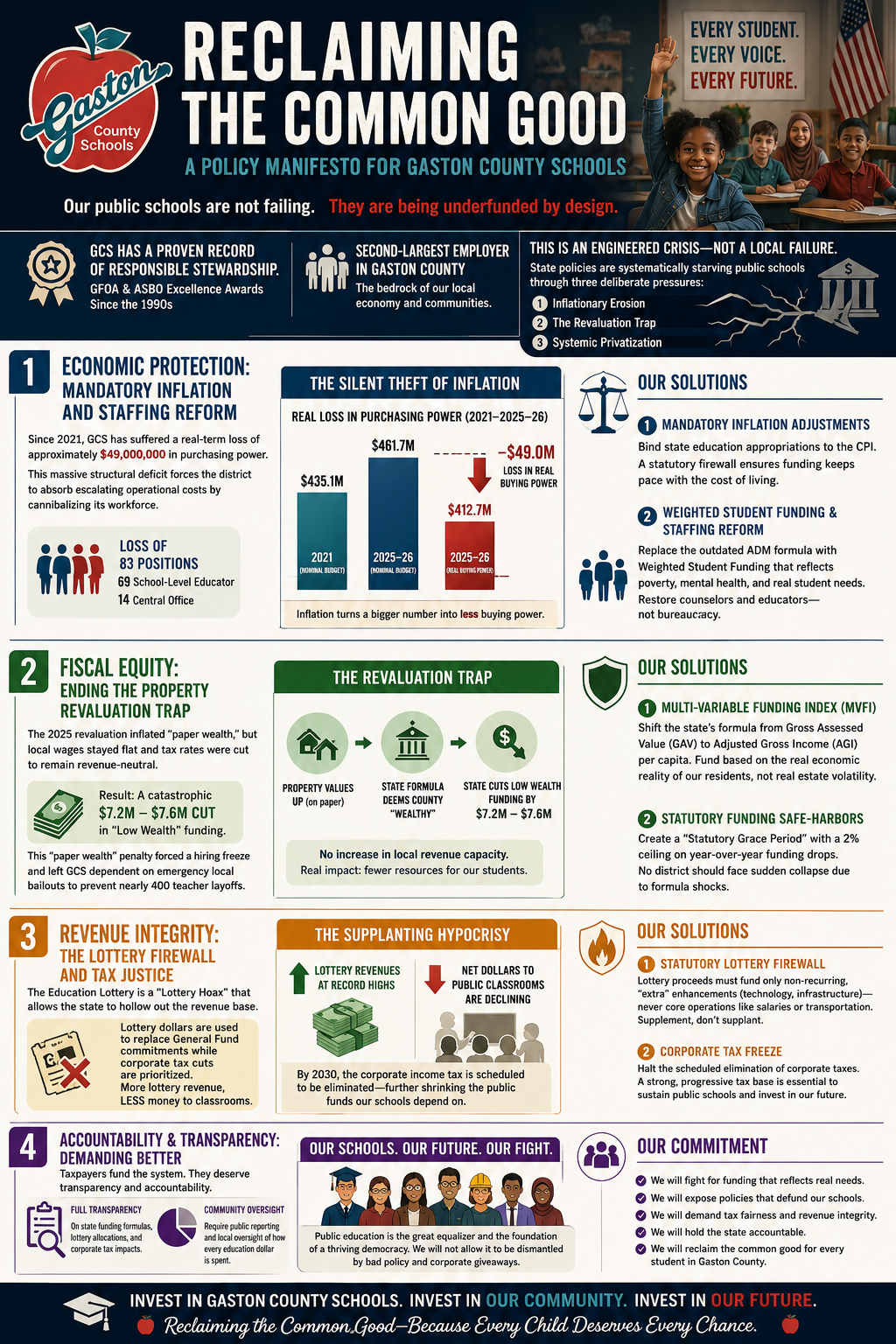
The fiscal instability currently paralyzing Gaston County Schools (GCS) is not a product of administrative failure or local mismanagement. To the contrary, GCS has long been a model of institutional responsibility, holding the GFOA Certificate of Achievement for Excellence in Financial Reporting and the ASBO Certificate of Excellence consistently since the 1990s. As the second-largest employer in the county, GCS is the bedrock of our local economy and social fabric.
The hardships the district faces—specifically the elimination of 69 school-level educator positions and 14 central office positions prior to the 2025–26 academic year—are the symptoms of an engineered crisis. This is a state-sanctioned campaign of “Progressive Starvation” and “Neoliberal Extraction” designed to hollow out public goods in favor of private interests. Our schools are being strangled by three deliberate systemic pressures:
- Inflationary Erosion: The “silent theft” of purchasing power through stagnant state funding.
- The Revaluation Trap: A flawed state funding formula that penalizes working-class districts based on paper property wealth.
- Systemic Privatization: The aggressive diversion of public tax dollars toward unaccountable private and charter entities.
2. Economic Protection: Mandatory Inflation and Staffing Reform
The narrative of “record funding” promoted by state leadership is a mathematical mirage. While nominal dollar figures may rise slightly, they fail to account for the skyrocketing costs of utilities, fuel, and healthcare.
The Silent Theft of Inflation
Since 2021, GCS has suffered a real-term loss of approximately $49,000,000 in purchasing power. This massive structural deficit forces the district to absorb escalating operational costs by cannibalizing its own workforce. The recent loss of 83 vital positions is the direct result of a state budget that refuses to acknowledge the reality of the Consumer Price Index (CPI).
Policy Solution 1: Mandatory Inflation Adjustments
We demand that state education appropriations be legally bound to the CPI. A statutory firewall must be established to ensure that the education budget scales automatically with the cost of living, preventing the state from quietly defunding schools through legislative and inflationary inaction.
Policy Solution 2: Weighted Student Funding & Staffing Reform
The current “State Allotment System” is an relic of austerity that treats children as standardized units. By tying funding strictly to a rigid Average Daily Membership (ADM) formula, the state ignores the complex needs of GCS’s 48% Title 1 campuses. We propose the abolition of the ADM formula in favor of Weighted Student Funding. This model must allocate resources based on actual student needs—including poverty metrics and mental health requirements—giving GCS the fiscal sovereignty to restore the counselors and educators lost to bureaucratic ratios.
3. Fiscal Equity: Ending the Property Revaluation Trap
The 2025 Gaston County revaluation serves as a definitive case study in state-level fiscal malpractice.
The Revaluation Trap
When Gaston County property values rose on paper during the 2025 revaluation, the state formula deemed the county “wealthy.” This was a fiction; local wages remained stagnant, and the Board of County Commissioners (BOCC) reduced tax rates to remain revenue-neutral. Despite no actual increase in local revenue capacity, the state triggered a catastrophic $7.2 million to $7.6 million cut in “Low Wealth” supplemental funding. This “paper wealth” penalty forced an immediate hiring freeze and left GCS dependent on emergency local bailouts to prevent nearly 400 teacher layoffs.
Policy Solution 1: Multi-Variable Funding Index (MVFI)
The state must immediately pivot to a Multi-Variable Funding Index. This proposal shifts the state’s low-wealth formula away from Gross Assessed Value (GAV) and prioritizes Adjusted Gross Income (AGI) per capita. Funding should reflect the actual economic reality of a county’s residents, not the volatility of a real estate bubble.
Policy Solution 2: Statutory Funding Safe-Harbors
We advocate for a “Statutory Grace Period” linked to the revaluation cycle. This policy would mandate a 2% ceiling on year-over-year funding drops, ensuring that no district faces a sudden budget collapse due to state formulaic adjustments.
4. Revenue Integrity: The Lottery Firewall and Tax Justice
The North Carolina Education Lottery has been transformed into a “Lottery Hoax” that facilitates the hollowing out of the state’s revenue base.
The Supplanting Hypocrisy
Under Section 7.3(g) of the state budget bill, local counties are legally forbidden from using state funds to supplant their local education spending. Yet, the state legislature routinely violates the spirit of this law. Lawmakers use lottery proceeds to replace General Fund commitments, creating a shell game that has enabled the scheduled phase-out of the corporate income tax by 2030. While lottery revenues hit record highs, the net dollar amount reaching public classrooms has actually declined as the General Assembly prioritized corporate tax cuts over public infrastructure.
Policy Solution 1: Statutory Lottery Firewall
We demand a legal mandate that lottery proceeds fund only non-recurring, “extra” enhancements—such as technology and infrastructure—ensuring they act as a supplement. Core operations, such as salaries and transportation, must be permanently tied to a robust, progressively taxed General Fund.
Policy Solution 2: Corporate Tax Freeze
To restore the state’s revenue base, we must halt the scheduled elimination of corporate taxes immediately. A public school system cannot be sustained on a dwindling tax base designed to benefit the affluent at the expense of rural and suburban students.
5. Restoring Public Accountability: Reforming the Voucher System
The expansion of “Opportunity Scholarships” has become a regressive wealth transfer. Statewide data reveals that 88.5% of voucher recipients in the 2025–26 school year were already enrolled in private schools, while only 11.5% were students transitioning from the public system.
Structural Exclusion
The voucher system is designed for “Structural Exclusion,” acting as a subsidy for the wealthy while locking out working-class families who cannot afford the “Tuition Gap.”
Grade Level | Max Voucher (Tier 2) | Gaston Christian Tuition | The Tuition Gap (Out-of-Pocket) |
Elementary | $6,918 – $7,468 | $10,060 | $2,592 – $3,142 |
High School | $6,918 – $7,468 | $13,478 | $6,010 – $6,560 |
Policy Solution 1: Reinstating Income Caps & Public Prerequisites
We must restore the program’s original intent. Eligibility must be restricted to families earning below the median income whose children are transitioning out of underperforming public schools.
Policy Solution 2: Private School Accountability Mandates
Any private institution accepting public funds must be held to public standards. This includes adherence to civil rights laws, non-discrimination policies, and academic testing requirements. Taxpayer dollars must not fund institutions that discriminate based on religion, disability, or sexual orientation.
6. Decoupling and Demographics: The Charter School Relationship
The current charter school model serves as a mechanism for Neoliberal Extraction, siphoning local funds while traditional schools maintain 100% of the fixed overhead for 5.1 million square feet of public facilities.
The Charter Drain and the Ridgeview Failure
GCS is currently forced to remit $6.8 million in local funds as a “pass-through” to charters. This extraction is often paired with academic failure. For example, Ridgeview Charter School, which served a high-poverty minority population, was closed in 2026 after proficiency rates fell 36 points below the GCS average. When these experiments fail, traditional public schools are forced to clean up the mess and absorb high-need students without the recovery of lost funds.
Policy Solution 1: Abolishing the Local Pass-Through Mandate
Charter schools should be funded directly through state-level appropriations. This allows local districts like GCS to retain 100% of their county tax dollars to maintain the physical infrastructure required to serve the majority of the community.
Policy Solution 2: Demographic Parity Laws
We demand that charter schools be required to match local district demographics as a condition for charter renewal. Currently, Piedmont Community Charter remains 52.7% White, while the City of Gastonia is over 30% Black. Charters must not be permitted to function as vessels of resegregation.
7. Conclusion: Organizing for Democratic Control
The 4-3 party-line vote in the Leandro V case represents a total judicial abdication of the state’s constitutional duty to provide a “sound basic education.” With the legal pathway for equity closed by partisan intervention, the battle for the common good has moved to the ballot box. The 2026 electoral shift—evidenced by Caroline Eason’s victory over a 15-year incumbent—proves that voters are ready to reject the managed decline of their schools.
Action Manifesto
To restore our schools and protect our children’s future, we must:
- Codify mandatory cost-of-living adjustments (CPI) for all state education appropriations.
- Abolish the “State Allotment System” and replace it with a Weighted Student Funding model.
- Overhaul the low-wealth formula by implementing a Multi-Variable Funding Index (MVFI) based on actual household income.
- Mandate a statutory lottery firewall to prevent the “Lottery Hoax” from supplanting the General Fund.
- Freeze the scheduled elimination of corporate income taxes to protect our state’s revenue sovereignty.
- Reinstate strict income caps and public-school prerequisites for all voucher recipients.
- Eliminate the local funding pass-through mandate for charter schools.
- Require strict demographic parity for any charter school receiving public funding.