
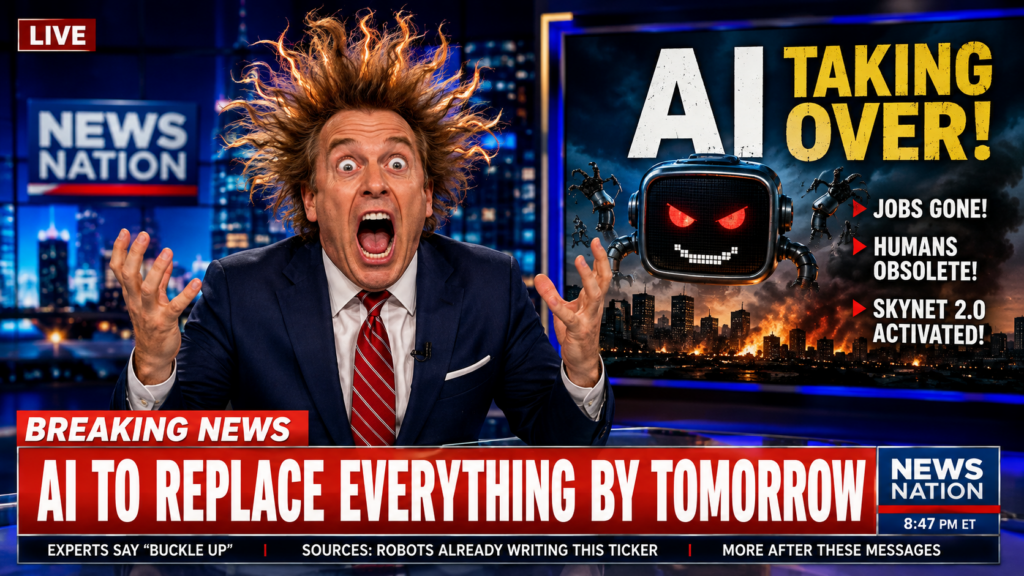
CBS Mornings has a guy they bring on to talk about AI. His name is Matt Shumer, and the chyron under his name says “CBS News Contributor.” He tells viewers things are moving “way more quickly than anyone anticipated.” Sounds like a neutral expert dropping in to explain the technical landscape, right?
Here’s what that chyron doesn’t tell you. Shumer runs a venture capital firm called Shumer Capital that invests in AI companies. He’s also the founder of an AI writing tool. And back in February, he published a viral essay called “Something Big Is Happening” that got shared something like 80 million times, in which he told readers to go sign up for the most expensive AI subscriptions they could find, because people with premium access would be the ones who survived what’s coming.
That’s not a neutral expert. That’s a man whose business depends on you believing him.
We’ve Seen This Show Before
Think about how you watch a political pundit. You already know, without even thinking about it, that the guy on the panel has a donor list, a party he’s carrying water for, a book to sell. You don’t take his certainty at face value. You discount it automatically, because you’ve learned that confident predictions on TV are a genre, not a forecast.
Now watch how differently people treat the AI guy. Same format. Same TV segment. Same guy with money riding on the answer he’s giving you. But because he’s talking about technology instead of politics, most people don’t apply the same skepticism. Tech sounds neutral. Engineering sounds like facts. “AI Contributor” sounds like a job description instead of what it actually is, which is a talking head with a stake in the outcome.
That’s the trick. Not that anyone’s lying, necessarily. It’s that the format launders self-interest into the appearance of expertise, and almost nobody’s guard is up for it the way it would be for a political ad.
The Pushback You Won’t See on CBS Mornings
Here’s the part that should bother you. Shumer’s essay didn’t go unanswered. Real critics tore into it.
Gary Marcus, a cognitive scientist who’s spent years studying the actual limits of these systems, called the essay “weaponized hype” and pointed out that Shumer was overstating what the models he’d worked with could actually do. A senior fellow at Harvard, writing in Forbes, said the piece read like a sales pitch dressed up as a warning. Fortune ran a piece bluntly titled around the idea that the only thing Shumer got right was that something is, in fact, happening. Everything past that, they argued, was built on assumptions that don’t hold up.
None of those people got a seat on CBS Mornings. Shumer did. That’s not an accident of scheduling. Confident, dramatic predictions make better television than “here’s the nuanced, uncertain reality.” The format selects for certainty, whether or not certainty is warranted.
A Few Questions Worth Asking
You don’t need a journalism degree to cut through this. You need the same instincts you’d already use on a political pundit, pointed at a new target.
Does this person make money if I believe them? Not “are they lying,” just, follow the money. A venture capitalist telling you AI is moving faster than anyone expected has a reason to want you to believe that, separate from whether it’s true.
Are they talking about what the technology does right now, or what it might do someday? A huge amount of AI coverage blurs “this exists and works” with “this is coming soon.” Those are different claims and deserve different levels of trust.
Have their past predictions held up? Pundits get invited back regardless of their track record. Check whether this person’s last big claim actually happened before you weight their next one.
Is there a citation, or just a vibe? “Experts say” and “it feels like” aren’t the same as a study, a dataset, or a named source you can go check yourself.
Sources That Actually Do the Work
If you want to follow AI coverage without marinating in hype or doom, here’s where I’d point you. None of these are perfect, and I’d read all of them with your own filter still on. But they’re a real step up from cable segments and viral essays.
Research-grounded, lowest hype:
- AI as Normal Technology (formerly AI Snake Oil) — a newsletter from two Princeton researchers who spend their time specifically separating real AI capability from marketing. If you read nothing else on this list, read this.
- Stanford HAI — publishes the annual AI Index, which is mostly data rather than narrative.
- Pew Research Center — solid on how ordinary people actually feel about and use AI, as opposed to how Silicon Valley assumes they feel.
Independent tech journalism, not chasing ad clicks off hype:
- 404 Media — founded by reporters who left Vice to do accountability journalism on tech without a corporate parent pulling punches.
- The Markup — data-driven reporting focused on how tech actually affects people, not how it’s marketed.
- Platformer (Casey Newton) — willing to say a tool is genuinely useful in one paragraph and name who’s getting hurt by it in the next.
Trade press worth reading, with a filter on:
- MIT Technology Review — the most consistently substantive of the mainstream tech outlets.
- Ars Technica — technically literate readership keeps the coverage more grounded than most.
Skeptics worth including on purpose:
- Gary Marcus (Substack) — not neutral, and says so. Useful precisely because he’s the guy checking industry claims against what the systems actually do.
- Ed Zitron — polemical, but backed by real reporting, and a good gut check against press releases dressed up as news.
Wire coverage, for a factual floor:
- AP and Reuters won’t give you depth, but they’re a decent baseline read before you go looking for takes.
This Isn’t a One-Time Read
Cutting through the noise isn’t a list you bookmark once. It’s a habit you rebuild every time a new viral essay or cable segment tells you the sky is falling or the future has arrived early. The AI story isn’t going anywhere, and neither is the incentive for people with money on the table to make sure you hear their version of it first and loudest.
Next time somebody’s introduced to you as an “AI Expert” or “AI Contributor,” ask the same question you’d ask about a pundit two seats down from him on a panel about the election. What does this person get if I believe them? Then go find out if the answer changes what they’re telling you.