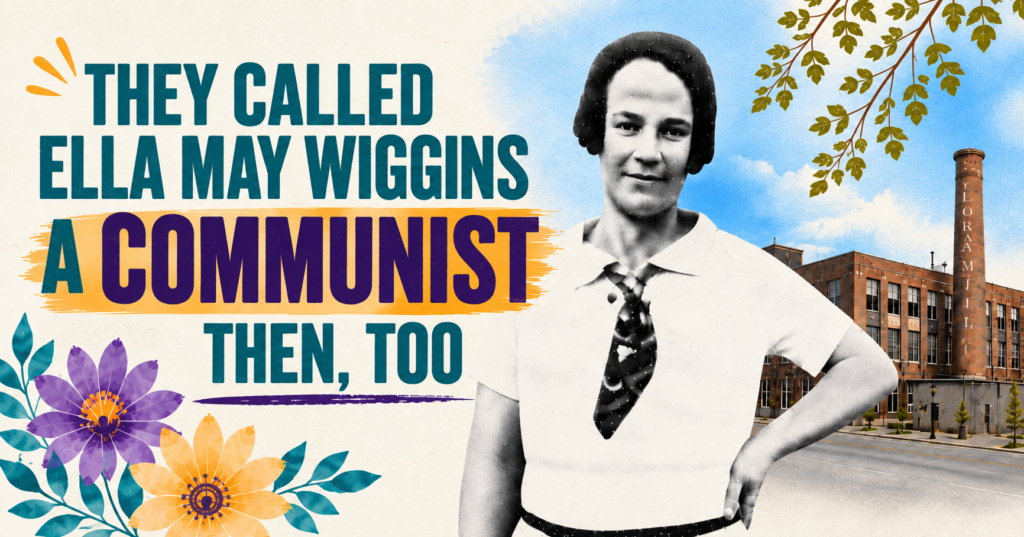
Ninety-seven years after a Bessemer City mill worker was murdered for organizing workers, our community is finally giving her a permanent place on its walls. Some of the reaction tells us just how little has changed.
On Monday, September 14, Bessemer City will unveil a mural honoring Ella May Wiggins.
That date isn’t accidental. Exactly 97 years earlier, on September 14, 1929, Wiggins climbed into a truck with other textile workers headed toward a union rally in Gastonia. She never made it. Armed men blocked the road. The workers turned around, were pursued, and were stopped again. Then the shooting started.
Ella May Wiggins, textile worker, mother, songwriter, labor organizer and one of the most remarkable people ever connected to Bessemer City, was shot and killed. She was not yet 30 years old.
97th Anniversary Commemoration
Ella May Wiggins Memorial Mural Unveiling
Monday, September 14, 2026
- 4:00 p.m. — Gravesite visit and history tour, Bessemer City Memorial Cemetery
- 5:00 p.m. — Mural unveiling, Virginia Ave. & N. 12th St., downtown Bessemer City
- 5:45 & 6:15 p.m. — Tours of American Mill No. 2, where Ella worked
- Immediately after — Music, food and celebration at Centennial Park, downtown Bessemer City
Hosted by the Ella May Wiggins Memorial Committee, with support from the Gaston Community Foundation, the Hendricks Foundation and the City of Bessemer City. Mural by artist Osiris Rain.
I have a small personal connection to this story. Beginning in 2017, I built and hosted the website for the Ella May Wiggins Memorial Committee. On the committee roster, my glamorous title was simply “Webmaster.” My role was a modest one compared with the historians, organizers, community advocates and others who spent years pushing the project forward, but it gave me a front-row seat to the effort to make sure Ella May Wiggins was no longer a largely forgotten footnote in Gaston County history.
The committee described itself as a group brought together by family, academic, community and historical interest in Ella May and in our textile heritage, with the goal of creating a lasting physical memorial to her. That website stayed online for years while the work continued.
Last year, I finally shut it down. Not because the effort had failed. Because, in the most satisfying sense possible, the website had largely finished its job. The goal had always been something tangible, something permanent in the community that would say Ella May Wiggins lived here, worked here, organized here and mattered here. Now that tribute is becoming real.
That makes watching some of the reaction to it especially strange. Because almost immediately, the familiar accusation appeared:
“She was a communist.”
And having spent years helping preserve the story the committee was trying to tell, I couldn’t help thinking: yes. We’ve heard this before.
First, let’s deal with the word “communist”
History shouldn’t be cleaned up to make its subjects easier to celebrate.
The National Textile Workers Union that organized the Loray Mill strike was Communist-led. It was part of the radical labor movement associated with the Communist Party in the United States. Ella May joined that union, became one of its most effective local organizers and worked alongside Communist organizers. That is a fact.
North Carolina’s own historical sources describe the NTWU as Communist-led, and Frank Porter Graham, then president of the University of North Carolina and himself opposed to the Communist union, later referred to Wiggins’ “mistaken Communism.”
So no, a serious account of Ella May’s life shouldn’t pretend that the Communist connection was invented out of thin air. But history requires us to ask the next question.
Why did Ella May Wiggins become a radical?
That’s where the Facebook version of history usually stops. Her actual life is where the story begins.
Nine dollars a week
By 1929, Ella May Wiggins was trying to raise five surviving children while working in Bessemer City’s textile industry. She earned about $9 a week.
Textile workers had been subjected to what they called the “stretch-out”: fewer employees expected to run more machinery and produce more goods, often while wages were being reduced.
The Loray strikers eventually demanded a $20 weekly minimum wage, a 40-hour workweek, equal pay for women, an end to the stretch-out and recognition of their union. Read that list again. A living wage. A 40-hour workweek. Equal pay. Reasonable workloads. The right to organize. The revolutionary demands of 1929 look remarkably ordinary from the vantage point of 2026.
Wiggins wasn’t sitting in a university seminar debating Marxist theory. She was working in a mill and trying to feed her children. She worked six days a week on long night shifts while raising her children after her husband abandoned the family. Four of the nine children she bore died amid the grinding poverty surrounding the family.
One of the most important things to understand about the Gastonia strike is that Communist organizers did not manufacture those conditions. They found them.
You can condemn communism until you’re out of breath and still be forced to confront the conditions that made its organizers attractive to desperate workers.
Then Ella did something even more dangerous
Ella May Wiggins wasn’t merely advocating higher wages. She began organizing Black textile workers alongside white textile workers. In Gaston County. In 1929.
Wiggins lived near and developed relationships with Black families in the Stumptown community outside Bessemer City. She independently organized Black workers and brought them into the union. At union gatherings there could literally be a line separating Black and white workers. Ella crossed it.
It’s difficult from nearly a century away to appreciate how radical that was. This was the Jim Crow South. White supremacy wasn’t simply an ugly opinion held by some people. It was embedded in law, politics, employment and daily social life.
A white working-class woman telling white and Black mill workers that their economic interests were connected challenged more than a textile company’s payroll. It challenged the mechanism that had been used for generations to keep Southern workers divided. And that made Ella May Wiggins dangerous.
She had another weapon: songs
Wiggins wasn’t a professional politician or trained organizer. She was a ballad singer. She took the musical traditions she knew from Appalachia and turned the experiences of mill families into songs.
Her most famous, “Mill Mother’s Lament,” wasn’t political theory dressed up as folk music. It was about children needing shoes their parents couldn’t afford and mothers leaving those children behind because mill wages couldn’t support them.
Folklorist Margaret Larkin watched Wiggins sing during the strike and concluded that her songs were “better than a hundred speeches.” That’s probably why her legacy survived when the strike itself largely did not.
Ella could translate an economic argument into something human. A wage isn’t an abstract statistic when your child needs shoes. A work schedule isn’t an ideological issue when your children are home without you. A union isn’t political theory when it is the only institution you’ve encountered promising that your life might become slightly less impossible.
That was Ella’s politics.
And then came the mobs
By September 1929, Gaston County had become extraordinarily volatile. Union headquarters had been attacked. Strikers had been evicted from company housing. Armed deputies and vigilantes were involved. Union members had been kidnapped, beaten and threatened.
After a mistrial involving union defendants accused in the death of Gastonia police chief O.F. Aderholt, mobs again attacked union facilities and terrorized organizers.
The NTWU called a mass meeting for September 14. Ella was supposed to sing.
Authorities and vigilantes established roadblocks to keep union supporters from reaching it. Wiggins and the workers traveling with her encountered one of them and turned back. They were chased. Ella was standing beside the rail of the truck when the men pursuing them opened fire.
She fell mortally wounded.
That should have been the moment political arguments stopped. It wasn’t.
“Communist.” “Riff-raff.” Sound familiar?
Even Ella’s murder became another opportunity to attack Ella. Five Loray Mill employees were eventually charged with killing her. There were scores of witnesses.
Potential witnesses were intimidated, and Wiggins herself was attacked during the trial. The defense emphasized that she was a single mother, called her a communist and characterized her as “riff-raff.”
The defendants were acquitted. Nobody was ever convicted of killing Ella May Wiggins.
Think about that the next time you see someone online casually wave away her entire story with one word. Communist. The word isn’t appearing 97 years later as some newly discovered historical revelation. It was part of the argument while her blood was still on the ground.
The most remarkable commentary may have come from someone who opposed her politics
Frank Porter Graham provides perhaps the best answer to today’s controversy.
Graham was president of the University of North Carolina. He wasn’t a Communist and didn’t support the Communist-led NTWU. But after Ella’s death, he refused to let disagreement with her politics excuse what had happened. He wrote:
“Her death is, in a sense, upon the heads of us all.”
And said that what he saw in her was not her “mistaken Communism, but her genuine Americanism.”
That was written in the context of 1929, not 2026. You don’t have to endorse communism to understand Ella May Wiggins. Frank Porter Graham managed that distinction almost a century ago. Surely we can manage it now.
Even the newspapers of 1929 saw the contradiction
There’s another piece of the historical record I find especially relevant to today’s debate.
After Ella’s murder, newspapers throughout the South, many of them openly hostile to communism, condemned what had happened. Their argument was essentially this: you cannot defend America from radicalism by abandoning American law.
The Literary Digest ran a roundup of those Southern editorials that September under the headline “Fighting Communism with Anarchy.” The Raleigh News and Observer asked why participation in a lawful labor organization should result in death at the hands of a mob. The Richmond News-Leader argued that government had an obligation to protect people’s rights whether they chose to organize or rejected organization. Even the Gastonia Gazette acknowledged that opposition to the movement didn’t give mobs license to act outside the law.
In other words, Southern newspaper editors in 1929 were already capable of saying: we oppose communism, and this woman still had rights. Apparently that nuance is now too complicated for a Facebook comment section.
What exactly are we honoring?
This may be the simplest part of the entire discussion.
A mural of Ella May Wiggins does not constitute an endorsement of every organization she joined, every political belief she held or every person with whom she worked. That’s not how history works. We honor historical people because their lives tell us something important about who we were and how we became who we are.
Ella May Wiggins belongs to Bessemer City’s story. She worked here. She raised her family here. She organized workers here. She crossed racial lines here. She wrote her songs here. She left here on September 14, 1929 expecting to sing those songs at a labor meeting. She came home dead. And she is buried here.
The Ella May Wiggins Memorial Committee remembers Wiggins as a mother, textile worker, union organizer and protest balladeer, and works to ensure Gaston County’s place in labor, industrial and social-justice history isn’t forgotten. That’s what Monday’s mural represents.
There is also an uncomfortable reason her story disappeared
Growing up around Gaston County, many of us learned a lot about the mills. They built our towns. Our grandparents and great-grandparents worked in them. The brick buildings are still scattered across our landscape.
But the history we inherited often celebrated the industry much more readily than it discussed what life inside that industry could be like.
Writer Wiley Cash grew up in Gastonia in a mill family and has written that he reached graduate school before he ever learned about Ella May Wiggins or the Loray Mill strike. That should tell us something.
History doesn’t disappear only because people intentionally destroy it. Sometimes communities simply decide which parts are comfortable enough to repeat.
Ella’s wasn’t. Poor woman. Single mother. Union organizer who crossed the color line. Murdered during a labor dispute whose killers walked free. That’s a complicated story. But complicated history is still history.
Maybe the comments are part of the memorial, too
There’s an irony I can’t quite get past.
For years, people worked to ensure Ella May Wiggins would finally have a prominent place in the community where she lived and worked. Now that the mural is about to be unveiled, some people are trying to discredit her by calling her a communist.
And somewhere, history is clearing its throat. Because we’ve heard this before.
The labels. The accusations about outside agitators. The suggestion that demands for economic dignity are really evidence of something sinister. The attempt to reduce a complicated human being to a word that makes it unnecessary to listen to anything she actually said.
Ella May heard all of it. She heard it before Facebook. She heard it before cable news. She heard it before our current political tribes existed. She heard it in 1929.
And then she was killed.
Monday, September 14, 2026, is the 97th anniversary of that killing. At 4 p.m., people will gather at her grave. At 5 p.m., a mural will be unveiled in downtown Bessemer City.
Nearly a century after someone tried to silence Ella May Wiggins with a bullet, her face is going onto a wall where everybody can see it.
I can’t think of a more appropriate answer.