
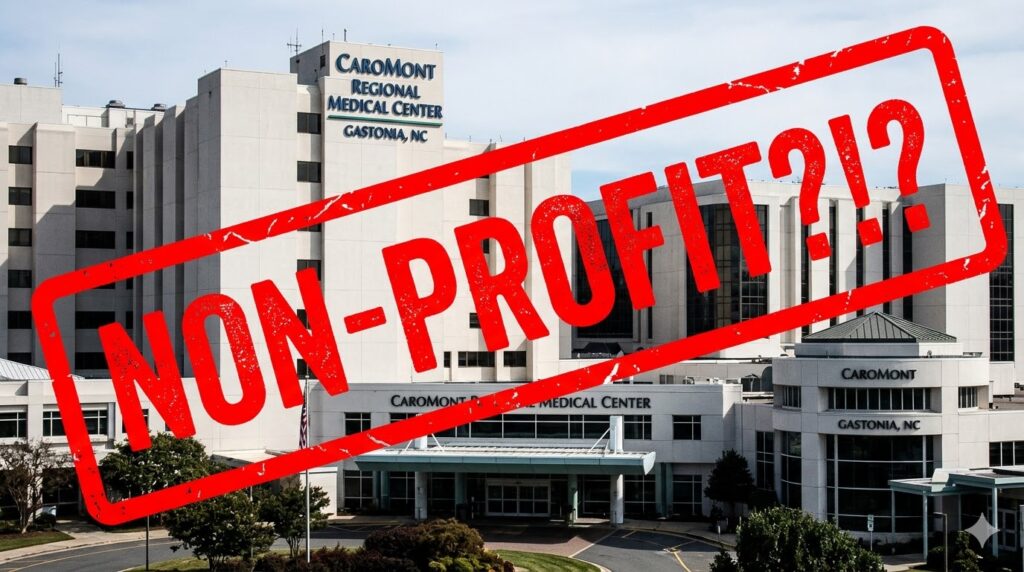
Is Our “Non-Profit” Hospital Actually Profiting Off Us?

A photograph of the CaroMont Regional Medical Center (Gastonia, NC) with a large, red, diagonal stamp across the front reading 'NON-PROFIT?!?' as a question about its financial status.

We need to talk about CaroMont Health.

Don’t get me wrong—we all want a world-class hospital in our backyard. We need the nurses, the docs, and the life-saving tech. But there’s a difference between a community asset and a corporate machine hiding behind a “non-profit” sticker. Lately, it feels like CaroMont is leaning a lot more toward the corporate side.

The $3.6 Billion Question

Let’s look at the numbers. According to the latest hospital data, CaroMont Regional Medical Center pulled in over $3.6 Billion in gross patient revenue last year. After all the bills were paid, they still sat on nearly $69 Million in net income.
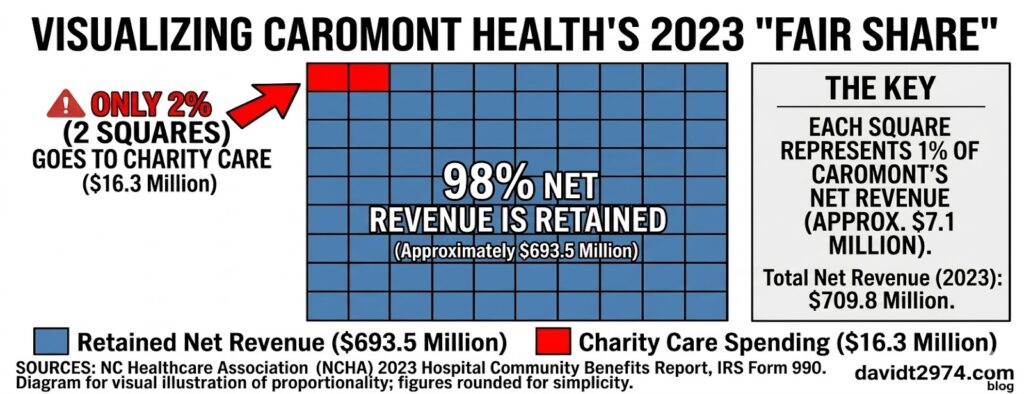
Out of over $700 Million in net revenue, CaroMont dedicated just 2.3% to charity care costs in 2023. Does that look like a ‘non-profit’ mission to you?

Now, look at what they gave back in actual Charity Care (the help for people who literally cannot pay). In 2023, that number was about $16.3 Million.

Think about that ratio. They are pulling in billions in revenue, but only about 0.4% of that gross revenue—or a fraction of their surplus—is going toward the “charity” that justifies their tax-free status. While the revenue climbs, the “Fair Share” we get back as a community is shrinking.
YearNet Operating RevenueCharity Care (Cost)% of Revenue
2017$552 Million$11.1 Million2.01%
2018$603 Million$14.0 Million2.32%
2019$636 Million$13.5 Million2.12%
2020$651 Million$12.3 Million1.89%
2023$709 Million$16.3 Million2.29%

The “Non-Profit” CEO

While charity care feels like an afterthought, executive pay sure isn’t. In 2024, CaroMont’s CEO took home a total compensation package worth over $2 Million. That’s a lot of “non-profit” money for one person, especially when the folks in our community are still drowning in medical debt.

According to the Lown Institute, CaroMont actually runs a $5 Million “Fair Share Deficit.” That means they are receiving $5 million more in tax breaks every year than they are giving back in meaningful community investment. We’re essentially subsidizing their expansion and their executive bonuses with our tax dollars.

Raleigh is Finally Watching (And They’re Angry)

For years, these big hospital systems have enjoyed a 100% property tax exemption. They pay zero. Zip. Zilch.

But the wind is shifting. On March 18, 2026, the NC House Select Committee on Property Tax Reform met to discuss a bombshell: Bill Draft 2025-DFxfz-5. If this becomes law, hospitals that don’t meet their charitable obligations could see their property tax exemption slashed from 100% down to 50%.


If CaroMont had to pay even half of their property taxes, that’s millions of dollars that could go back into Gaston County schools, sheriff’s deputies, and paved roads.

The “Landlord” Card

Here’s a bit of Redneck Wisdom for you: He who owns the dirt makes the rules.

Most folks don’t realize that Gaston County actually owns the 180 acres and the buildings on Court Drive. CaroMont is just the tenant, and their lease runs until 2035. That means our County Commissioners aren’t just bystanders—they are the landlords.

It’s time our Commissioners used that leverage. When CaroMont comes asking for more land or new permits, the response should be: “Sure, as soon as you implement Presumptive Eligibility.”

The Solution: Stop the Paperwork War

Right now, if you’re struggling, CaroMont makes you jump through hoops of red tape to get financial aid. It’s invasive and exhausting.

Presumptive Eligibility is simple: If a patient already qualifies for SNAP or Medicaid, the hospital should automatically qualify them for charity care. If the government already knows you’re broke, the hospital shouldn’t be allowed to pretend they don’t.

The Bottom Line

We’re the ones who make CaroMont successful. We’re the patients, the donors, and the ones giving them a free ride on their property taxes. It’s time we stop asking for “care” and start demanding the accountability we’ve already paid for.

Source Citations:

Scroll to Top