If you bought a home in Gaston County prior to 2023, you likely watched with a mix of shock and bemusement as local real estate values soared. In late 2025, a mandatory countywide property revaluation revealed that the average value of residential dwellings had skyrocketed by an astonishing 1.85 times since 2022. On paper, Gaston County had suddenly become a hotbed of real estate wealth.
But for Gaston County Schools (GCS) and the families it serves, this paper prosperity became a financial trap.
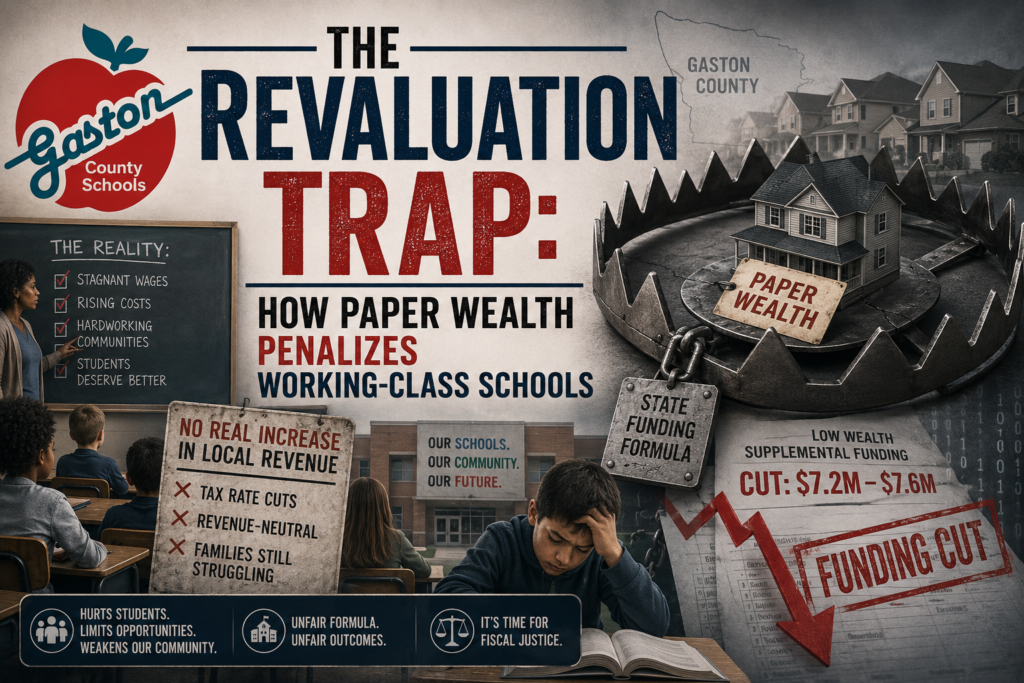
In December 2025, GCS Superintendent Dr. Morgen A. Houchard delivered a devastating announcement to school staff: because Gaston County’s property values had risen so dramatically, the state of North Carolina slashed the district’s “Low Wealth Supplemental Fund” by over $7.2 million.
To stabilize the budget, the district was forced to implement an immediate countywide hiring freeze, locking out new teachers and support staff. This was followed by a frantic race against bankruptcy, resolved only when the Gaston County Board of County Commissioners (BOCC) approved two massive, short-term emergency bailouts—$3.5 million in February 2026, and another $10 million in March 2026—just to prevent the immediate layoff of nearly 400 local educators and support personnel.
This is the story of The Revaluation Trap—a glaring institutional failure that exposes how capitalist, property-based funding formulas actively penalize working-class children, transfer financial burdens to local taxpayers, and create artificial staffing crises in our classrooms.
The Formula of Inequality: Why Paper Wealth!= Actual Resources
To understand how a housing bubble can decimate a school budget, we have to look at the bureaucratic math used by the North Carolina General Assembly.
The state’s “Low Wealth Counties Supplemental” fund is designed to allocate extra dollars to districts that lack the local tax base to fund schools at the state average. Under North Carolina law, a county’s eligibility for these supplements is calculated using a rigid formula:
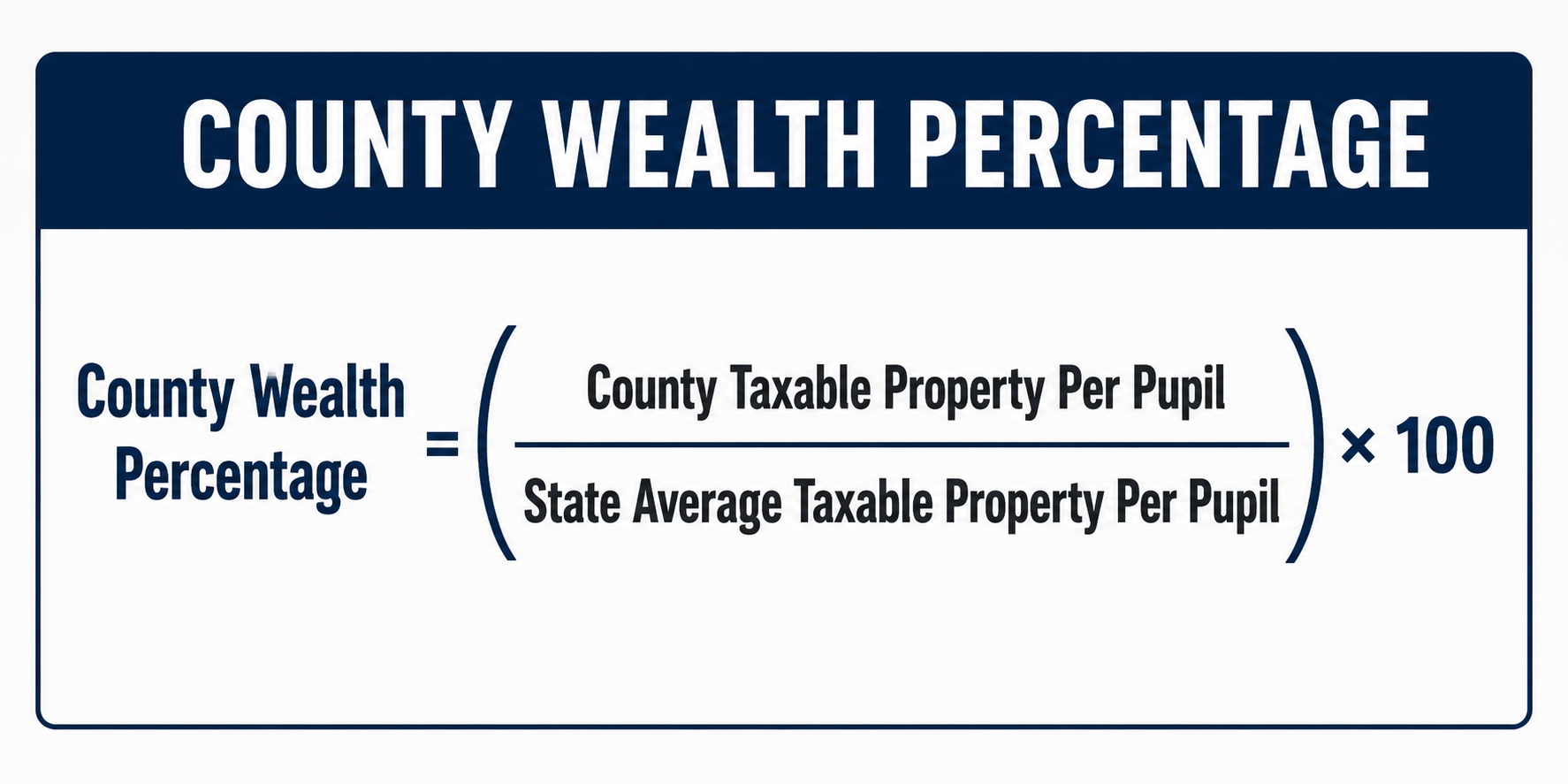
If a county’s wealth percentage rises toward 100% of the state average, its state low-wealth funding is systematically reduced or stripped entirely.
Here lies the structural failure of this metric: it measures the paper value of real estate, not the actual income of the people who live in those homes.
In Gaston County, approximately 48% of public schools operate as high-poverty Title 1 campuses. The fact that a working-class family’s home value doubled due to a national housing bubble does not mean that family’s paycheck doubled. Their income remained flat, their grocery bills rose with inflation, and yet, because their house was worth more on paper, the state’s formula concluded that Gaston County was suddenly “wealthier” and no longer required state support.
The Revenue-Neutral Shell Game
When property values rise during a revaluation, North Carolina counties are pressured to reduce their nominal property tax rates to achieve “revenue neutrality”—ensuring the county does not get a massive, unearned windfall of tax dollars. Gaston County did exactly this, dropping its county tax rate to $0.5990 in 2025.
This created a perfect storm for the school district:
The State Cut: Because total property values went up, the state slashed GCS’s low-wealth supplement by $7.2 million to $7.6 million.
No Local Windfall: Because the county commissioners lowered the tax rate to remain revenue-neutral, the county did not collect a massive wave of new cash to replace what the state took.
The Charter Siphon: To make matters worse, GCS was mandated by the state to hand over $6.8 million of its limited $54.0 million local county appropriation directly to privately managed charter schools.
GCS was caught in a vice. The state assumed the county would make up the difference because of the revaluation, but the county had no new revenue stream to do so. The district had already allocated those expected low-wealth funds to recurring teacher and counselor payrolls.
The Working-Class School Squeeze
How systemic state formulas and local constraints trap Gaston County’s public classrooms:
- 🛑 The State Action: A mandatory property revaluation inflates home values. The state’s formula assumes the county is suddenly “wealthier” and slashes GCS’s Low-Wealth Supplemental funding by $7.2 million to $7.6 million.
- 🛑 The Local Constraint: To prevent a sudden tax spike on residents, the county lowers its nominal tax rate. This means the county collects no new tax revenue to replace the millions stripped by the state.[1]
- 🛑 The Charter Extraction: Simultaneously, GCS is legally mandated to pass $6.8 million of its remaining local budget directly to private charter schools.[1]
- 💥 The Result: GCS is squeezed into a corner, forcing an immediate hiring freeze and leaving the district entirely dependent on short-term county bailouts just to keep teachers in classrooms.[2]
Without the emergency intervention of county commissioners—who had to scramble to authorize $13.5 million in emergency funds in early 2026 —Gaston County public schools would have experienced a catastrophic wave of mid-year layoffs. As Cramerton Middle School teacher Brittany Elkin passionately testified before the commissioners, Gaston County already ranks 85th out of 100 North Carolina counties in per-pupil funding, spending 10% to 15% less per student than peer counties. The revaluation trap nearly broke an already struggling system.
The Progressive Action Plan: Overhauling a Broken System
This cycle of starvation and temporary local emergency bailouts is completely unsustainable. It treats public school funding like an erratic charity rather than a fundamental constitutional right. To protect GCS from future real estate shocks, we must advocate for two structural reforms:
1. Replace Property Value with Median Household Income in Funding Formulas
The General Assembly must stop using paper real estate values to measure a community’s wealth. The state low-wealth funding formula should be rewritten to base school funding on actual household income metrics (such as the percentage of families qualifying for free or reduced-price lunch, median household income, and local wage growth). This ensures that low-wealth supplements continue flowing to districts where families are actually struggling, regardless of real estate bubbles.
2. Establish “Safe-Harbor” Funding Ceilings
The state must establish a statutory “safe-harbor” rule. No school district should lose more than 2% of its state low-wealth allotment in a single fiscal year due to property revaluations. This would give local school boards and county commissioners a multi-year runway to adjust to funding changes, preventing sudden, mid-year hiring freezes and emergency panic.
The Bottom Line
The Revaluation Trap is a textbook example of systemic disinvestment disguised as objective mathematical formulas. It is an indictment of a state government that uses property values as an excuse to wash its hands of its constitutional obligation to provide every child with a “sound basic education”.
In our next article, we will expose The Lottery Hoax, showing how state leaders have used record-breaking lottery sales as a replacement for traditional tax revenues, clearing the way for corporate tax cuts while our classrooms go without basic supplies.
We must demand a school funding model based on human need, not property speculation. Share this article, and write to your state representatives to demand an overhaul of the NC Low Wealth Supplemental formula.
Sources & Further Reading
Wise News Network (WNN)
“Gaston County Schools Suffer the Consequences as Gaston County’s Value Grows” (December 16, 2025). Detailing the property revaluation metrics, the $7.2 million Low Wealth fund cut, and the subsequent district hiring freeze.
“Gaston County Commissioners Approve $10 Million in Emergency Funding to Prevent Nearly 400 Layoffs” (March 24, 2026). Coverage of Superintendent Houchard’s budget presentation and the emergency county bailouts.
Gaston County Schools Board of Education
Official 2025–2026 Annual Budget Resolution. Approved November 17, 2025, detailing the $7.6 million Low Wealth Counties Supplemental funding reduction and the $6.8 million charter school pass-through.
North Carolina General Assembly
North Carolina General Statutes § 115C-218 (Low-Wealth Counties Supplemental Funding Eligibility). Explaining the formula and property valuation ratios used to calculate wealth-based school allotments.