
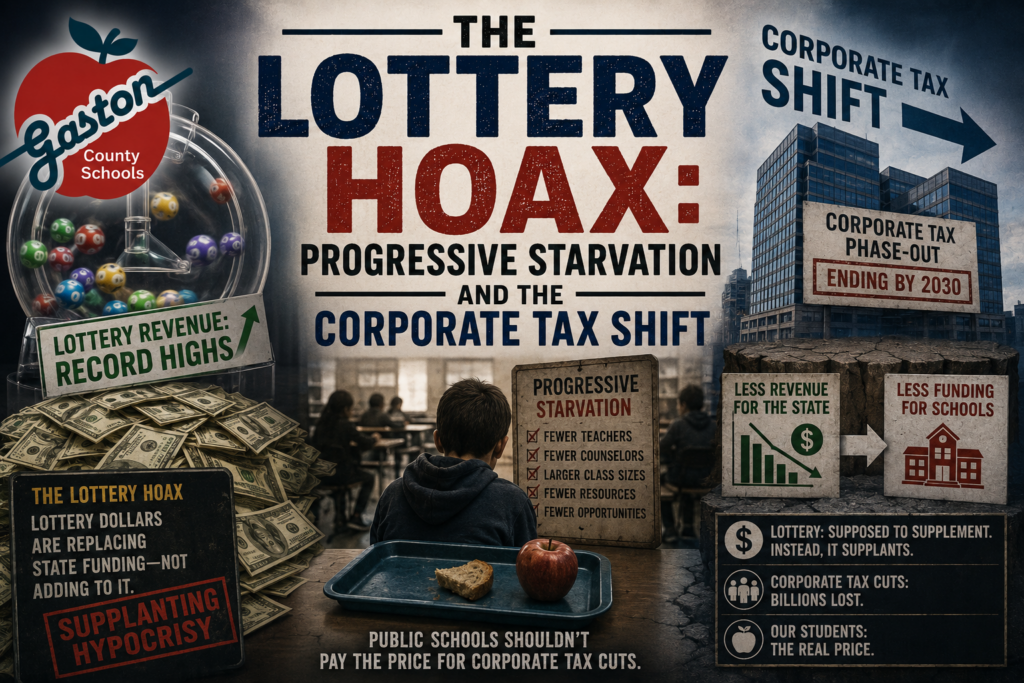
The Lottery Hoax: Progressive Starvation and the Corporate Tax Shift

Every year, millions of North Carolinians purchase scratch-offs or Powerball tickets, comforted by a ubiquitous state slogan: “Supporting Education.” When the North Carolina Education Lottery was established in 2005, it was sold to the public on a simple, comforting promise: net lottery proceeds would directly supplement public classrooms, giving our schools an extra financial boost above and beyond traditional state funding.

But to a political scientist analyzing the state’s budget history, the reality is far more cynical.

The lottery has been transformed into a massive, regressive shell game. While everyday working-class citizens pour billions of dollars into lottery tickets, state lawmakers have quietly used those revenues to supplant traditional general tax commitments.

By using voluntary lottery dollars to replace the General Fund money that should be funding our schools, the General Assembly has successfully cleared a multi-billion-dollar runway to enact historic, sweeping tax cuts for multinational corporations and the ultra-wealthy.

Our schools aren’t getting extra resources. Instead, the working class is being taxed twice—once through a regressive lottery, and again through under-resourced public schools—all to subsidize the complete phase-out of corporate taxes.

The Supplement vs. Supplant Paradox

To understand how this shell game works, we have to look at the legal definitions of supplementing (adding extra resources) versus supplanting (replacing existing resources).

State lawmakers are highly strict about this rule when it comes to local counties. Under North Carolina law, local county commissioners are legally barred from using state education allocations to reduce their own county-level appropriations to schools. To enforce this, Section 7.3(g) of the state budget bill dictates that a county’s per-student current expense appropriation must not fall below a specific threshold compared to prior years :
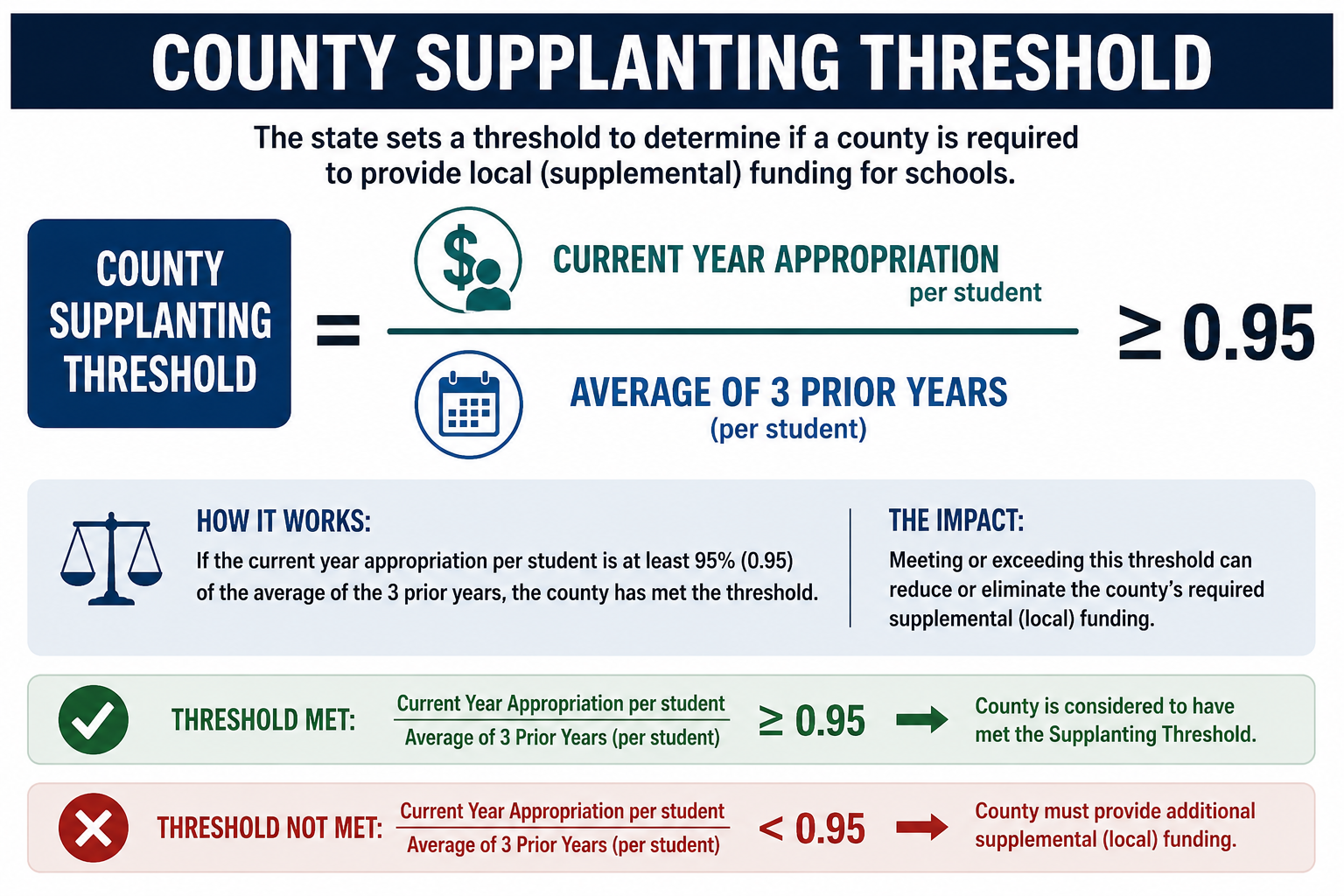
 

If a county’s funding falls below this 95% threshold, the State Board of Education is authorized to withhold state funding, accusing the county of “supplanting” its local obligations with state dollars.

Yet, while the state holds local counties to this strict standard, the state General Assembly has exempted itself from any such fiscal discipline.

Over the last decade, state budget writers have routinely used growing lottery revenues to fund baseline educational operations—such as school transportation, custodians, and non-instructional support staff—that were historically paid for out of the state’s General Fund. By shifting these recurring, essential expenses onto the lottery, the state has quietly freed up billions of general tax dollars.
The Audit That Exposed the Hoax

This state-level redirection of funds is not a conspiracy theory—it is a documented financial fact.

A December audit of the North Carolina Education Lottery brought this shell game to light. The audit revealed a shocking truth: while the lottery’s annual revenue increased by more than $1 billion, the actual net dollar amount distributed to public schools declined over the same period.

How is it possible that a public asset can generate $1 billion more in revenue while our classrooms receive less support?

In North Carolina, the corporate income tax rate — which sat at a modest 2.5% — is on a statutory path to be completely phased out and eliminated by 2030. Simultaneously, the state’s personal income tax rate is being aggressively slashed, projected to drop to a flat 2.99% by 2028 thanks to legislative ‘revenue triggers.

This is the core of progressive starvation: the state is systematically dismantling its progressive tax base. To make up for the massive revenue loss from cutting corporate and high-income taxes, the state relies on regressive revenue generators like lottery sales.

The wealthy get a tax break; the public gets a casino-style funding model that underfunds districts like Gaston County Schools—which currently ranks 85th out of 100 North Carolina counties in per-pupil funding.

Targeted Crumbs: The Mirage of the “Directed Grant”

To keep local communities from rebelling against this systemic disinvestment, state politicians employ a classic public relations tactic: the “directed grant.”

When public school advocates complain about systemic funding shortages, local legislators love to return to their home districts bearing oversized novelty checks for highly specific, localized projects.

For example, the General Assembly recently approved a highly targeted $150,000 directed grant to Gaston County Schools specifically earmarked for field turf repairs and renovations at Stuart W. Cramer High School.

While a new athletic field is undoubtedly a positive upgrade for the students of Cramer High, this localized crumb does absolutely nothing to address the broader structural deficit facing Gaston County Schools.

A one-time $150,000 athletic grant is a drop in the bucket for a district that:

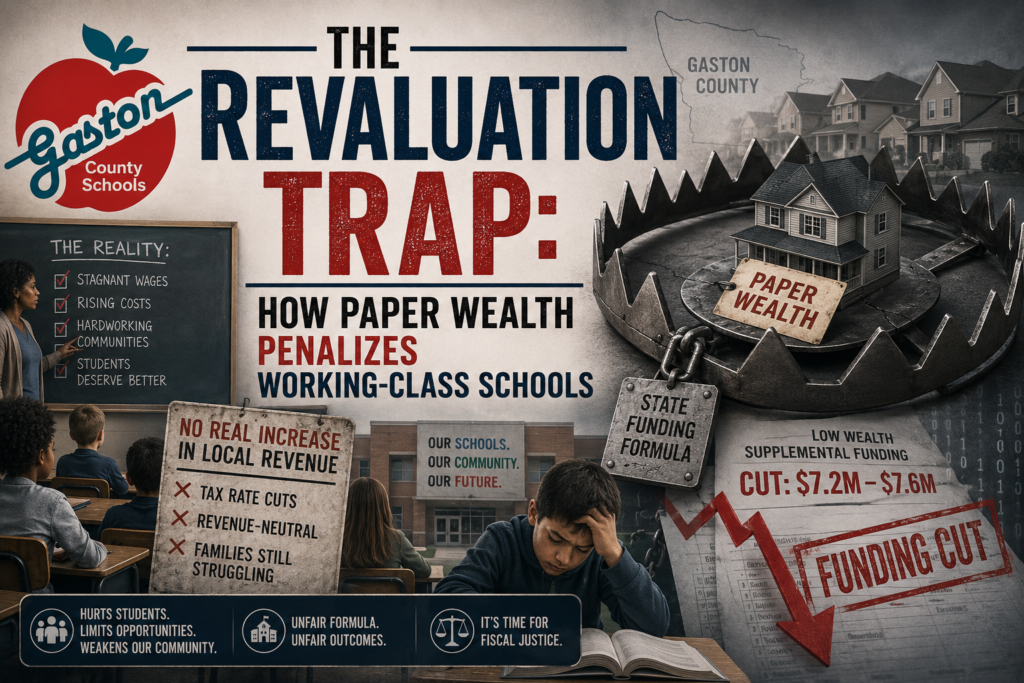
  • Was forced into a system-wide hiring freeze due to a $7.2 million state low-wealth funding cut.

  • Must maintain over 5.1 million square feet of aging school buildings, most of which are over 40 years old, on a flatlined local capital budget.

  • Had to eliminate 69 school-level positions and 14 central office positions to align with rigid state allotments.

These targeted grants are political distractions. They allow politicians to claim they are “delivering for Gaston County” while they actively vote to phase out the corporate tax revenues that could permanently fund class-size reductions, counselor hires, and building repairs across the entire district.

The Progressive Action Plan: How We Reclaim Our Public Funds

Relying on scratch-off tickets to fund the constitutional right to a “sound basic education” is a moral and economic failure. To stop the state-level supplanting of school funds and restore fiscal sanity, we must organize around a bold, progressive policy agenda:

1. Codify a State-Level “Lottery Firewall”

Just as local counties are barred from supplanting local funds, the North Carolina General Assembly must be bound by a strict statutory firewall. State law must mandate that General Fund appropriations for core educational operational expenses (like teacher salaries, student support services, and utilities) must scale with inflation and enrollment. Lottery proceeds must be legally restricted to non-recurring, voluntary “classroom enhancements” (such as state-of-the-art laboratory equipment, advanced student technology, or new facility construction), ensuring lottery dollars actually supplement a robustly funded baseline public system.

2. Freeze the Corporate Tax Phase-Out

We must immediately halt the scheduled elimination of North Carolina’s corporate income tax and reverse the regressive personal income tax cuts. Reinstating a fair, progressive tax on major corporations is the only way to build a stable, non-volatile revenue stream that can permanently lift Gaston County Schools out of its perpetual funding crises. Our children’s education should be guaranteed by a healthy, progressively taxed society, not the financial losses of working-class lottery players.

The Bottom Line

The next time you see a commercial celebrating the millions of dollars the NC Education Lottery brings to local classrooms, remember the shell game. Gaston County’s teachers are not facing payroll issues and hiring freezes because there isn’t enough wealth in North Carolina; they are facing them because that wealth has been systematically tax-sheltered, leaving public schools to survive on crumbs.

In our next article, we will examine Vouchers and the State-Funded Flight, detailing how state lawmakers are shifting from siphoning public general funds to directly routing public tax dollars into unaccountable private and religious academies.

Our schools deserve a guaranteed future, not a roll of the dice. Share this article, and demand that our state leaders fund classrooms by taxing corporate profits, not working-class pockets.

Sources & Further Reading

  • EducationNC (EdNC)

    • “North Carolina Education Lottery Revenue Up, But Less Money Went to Schools” (January 21, 2026). Detailing the state audit which revealed that as lottery revenue grew by over $1 billion, school allocations declined.

    • “Property Tax Limits and State-Level Revenue Declines Strain Tight School Budgets” (2025). Detailing the complete phase-out of North Carolina’s corporate income tax by 2030 and planned drops in the personal income tax rate.

  • North Carolina General Assembly (NCGA)

    • North Carolina General Statutes § 115C-562.1 (The North Carolina School Business Systems Modernization and Budget Allotments). Explaining Section 7.3(g) and the 95% local non-supplanting requirements.

    • North Carolina Session Law (Gaston County Directed Grants). Detailing the $150,000 directed grant for turf repairs at Stuart W. Cramer High School.

  • Public School Forum of North Carolina

    • Local School Finance Study & Per-Pupil Spending Reports. Highlighting Gaston County’s ranking as 85th out of 100 counties in local per-pupil funding.

Scroll to Top