
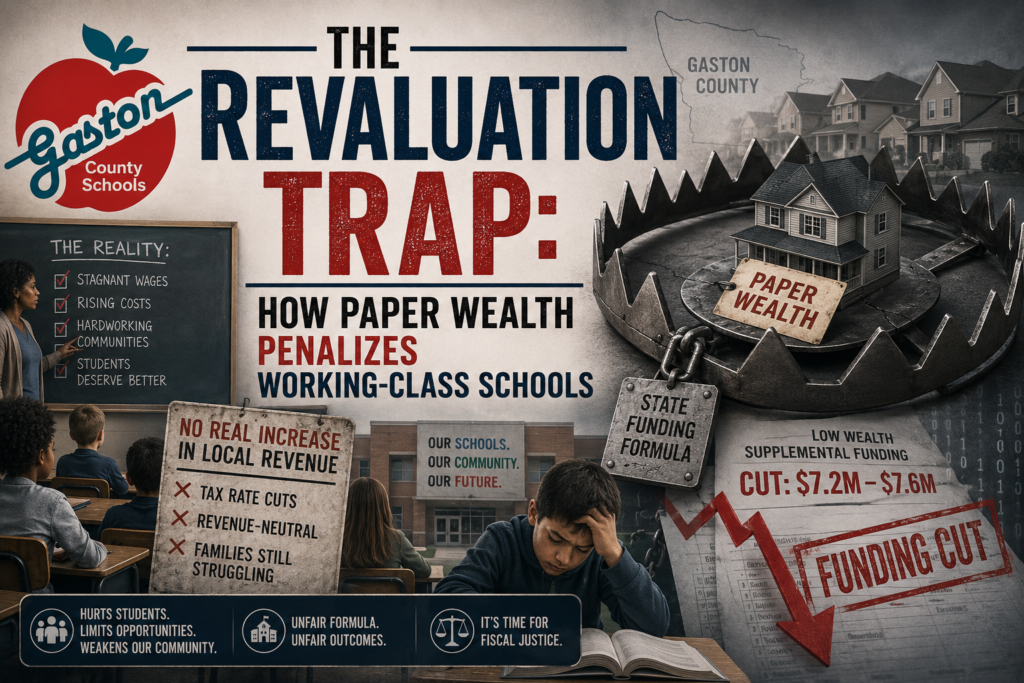
The Revaluation Trap: How Paper Wealth Penalizes Working-Class Schools

If you bought a home in Gaston County prior to 2023, you likely watched with a mix of shock and bemusement as local real estate values soared. A mandatory countywide property revaluation that took effect in 2023 revealed that real estate values had risen significantly. On paper, Gaston County had suddenly become a hotbed of real estate wealth. But for Gaston County Schools (GCS) and the families it serves, this paper prosperity became a financial trap.

The Cumulative Tax Burden

While the Gaston County Board of Commissioners aimed for a “revenue-neutral” tax rate—dropping the rate from $0.81/$100 to $0.599/$100 in 2023—this did not protect most residents from a tax hike. Because property values increased more sharply than the tax rate decreased, many homeowners have been paying higher real estate taxes for three consecutive cycles (2024, 2025, and 2026).

From the perspective of a taxpayer, this means that while residents have been paying increased taxes to the county, the school system has simultaneously faced a worsening funding crisis. This highlights a critical disconnect: higher local tax payments have not translated into increased stability for our classrooms.

The Formula of Inequality: Why Paper Wealth Doesn’t Equal Actual Resources

The fiscal pressure on our schools is compounded by the bureaucratic math used by the North Carolina General Assembly. The state’s “Low Wealth Counties Supplemental” fund is designed to allocate extra dollars to districts that lack the local tax base to fund schools at the state average.

Under North Carolina law, a county’s eligibility for these supplements is calculated using a rigid formula:
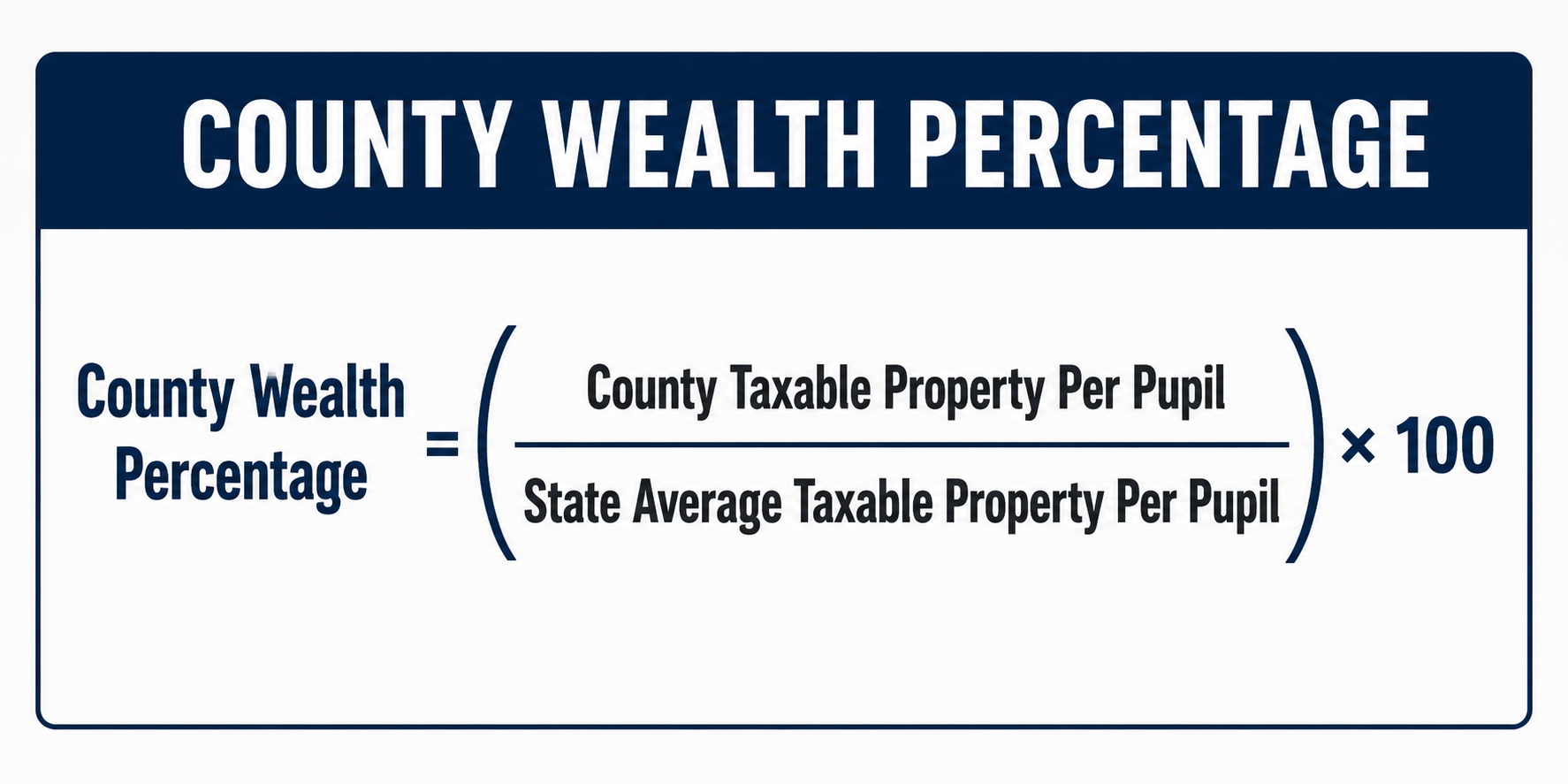
If a county’s wealth percentage rises toward 100% of the state average, its state low-wealth funding is systematically reduced or stripped entirely. This metric fails because it measures the paper value of real estate, not the actual income of the residents. Nearly half of our public schools operate as high-poverty Title 1 campuses, yet because home values rose due to a national housing bubble, the state formula incorrectly concluded that Gaston County no longer required support.
A Multidimensional Crisis

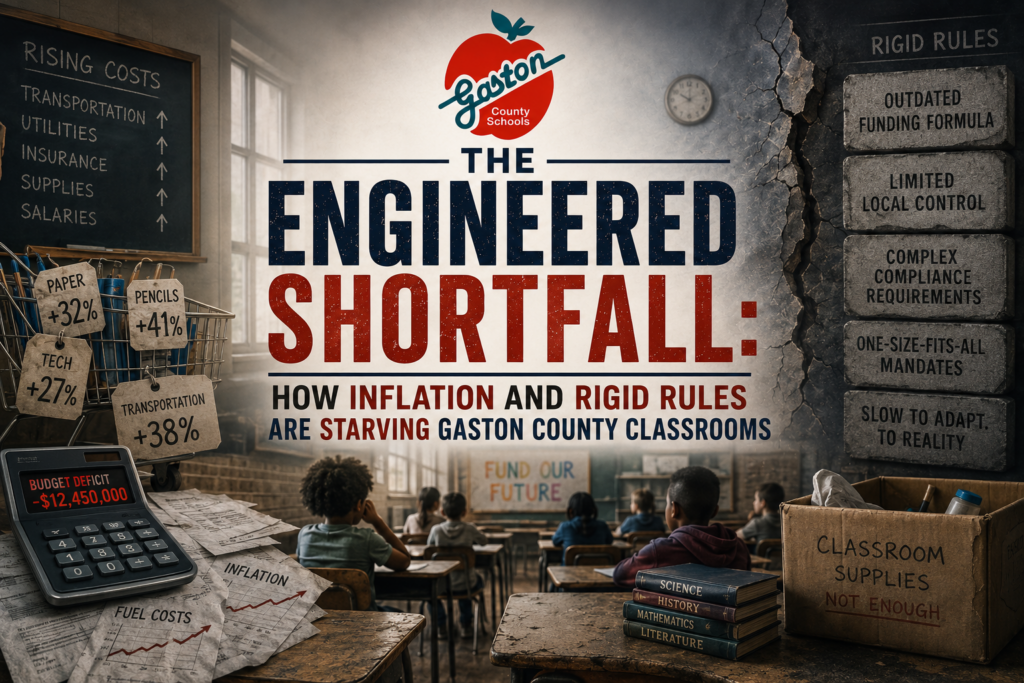
We must be clear: the school funding crisis is not the result of one single factor, but a perfect storm of systemic issues:

  • Structural Funding Penalties: The state’s reliance on property values to determine “wealth” led to a reduction in crucial low-wealth supplemental funding.

  • Fiscal Erosion: The district has been forced to navigate the exhaustion of federal ESSER pandemic-relief funds, which were previously used to cover recurring operational costs.

  • Administrative Burdens: Ongoing issues with the district’s payroll system, which has faced significant functionality challenges for several years, have added an unconscionable layer of administrative and financial strain.

  • The Charter Siphon: GCS remains legally mandated to remit a portion of its local operating funds directly to charter schools, further depleting the budget available for traditional public classrooms.

The Progressive Action Plan

We cannot continue to treat public school funding like an erratic charity. To protect GCS, we must advocate for structural reforms:

  1. Replace Property Value with Median Household Income: The General Assembly must rewrite the low-wealth funding formula to prioritize actual household income metrics (such as the percentage of families qualifying for free or reduced-price lunch) over volatile real estate appraisals.

  2. Establish “Safe-Harbor” Funding Ceilings: The state should enact a statutory rule preventing any school district from losing more than 2% of its state low-wealth allotment in a single fiscal year due to revaluations, providing a necessary buffer against sudden budget shocks.

The Bottom Line

The “Revaluation Trap” is a textbook example of systemic disinvestment disguised as objective mathematical formulas. It is an indictment of a state government that uses paper property values as an excuse to wash its hands of its constitutional obligation to provide every child with a “sound basic education.” We must demand a school funding model based on human need, not property speculation.

Sources & Further Reading

  • Wise News Network (WNN)

    • “Gaston County Schools Suffer the Consequences as Gaston County’s Value Grows” (December 16, 2025). Detailing the property revaluation metrics, the $7.2 million Low Wealth fund cut, and the subsequent district hiring freeze.

    • “Gaston County Commissioners Approve $10 Million in Emergency Funding to Prevent Nearly 400 Layoffs” (March 24, 2026). Coverage of Superintendent Houchard’s budget presentation and the emergency county bailouts.

       
  • Gaston County Schools Board of Education

    • Official 2025–2026 Annual Budget Resolution. Approved November 17, 2025, detailing the $7.6 million Low Wealth Counties Supplemental funding reduction and the $6.8 million charter school pass-through.

       
  • North Carolina General Assembly

    • North Carolina General Statutes § 115C-218 (Low-Wealth Counties Supplemental Funding Eligibility). Explaining the formula and property valuation ratios used to calculate wealth-based school allotments.

Scroll to Top