For decades, Gaston County Schools (GCS) stood as a quiet beacon of public sector efficiency and financial stewardship. As the second-largest employer in Gaston County—supporting a dedicated workforce of over 3,800 educators and support staff —the district consistently earned the highest marks for financial reporting. It regular received the Certificate of Achievement for Excellence in Financial Reporting from the Government Finance Officers Association (GFOA) and the Certificate of Excellence from the Association of School Business Officials (ASBO).
Yet, despite this sterling record of institutional responsibility, Gaston County’s public classrooms are currently facing a devastating resource deficit. Prior to the 2025–26 academic year, Gaston County Schools was forced to eliminate 69 school-level educator positions and 14 central office positions just to keep its doors open.
How does an award-winning, highly responsible public school system find itself pushed to the absolute brink of fiscal exhaustion?
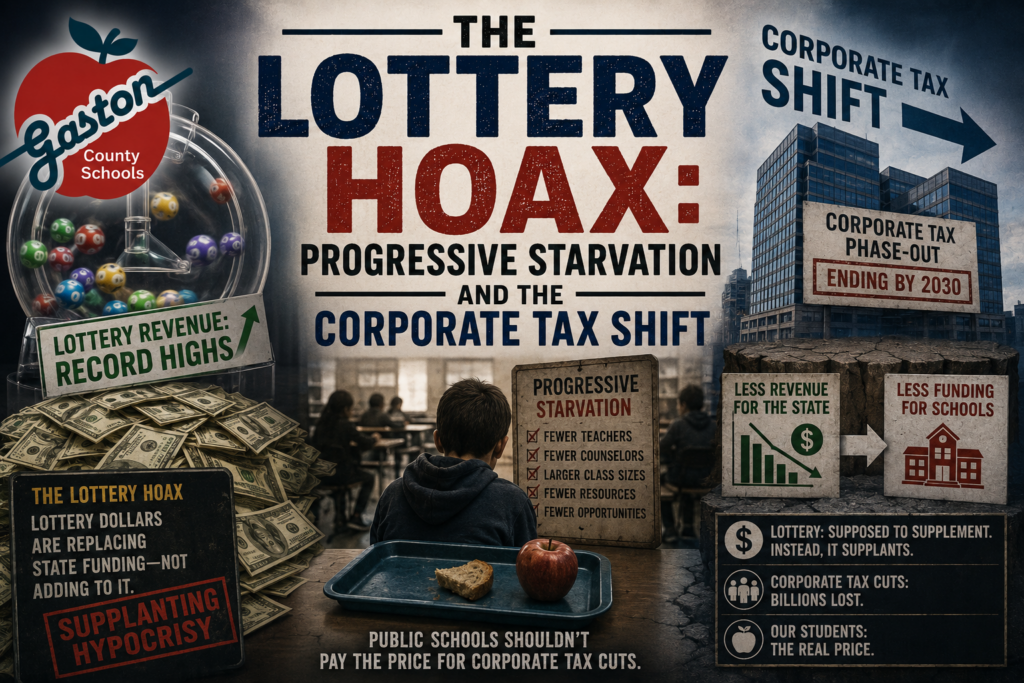
To a political scientist analyzing the landscape, the answer is clear: this is not an accidental administrative failure. It is an engineered crisis—the direct result of systemic state-level funding starvation, silent inflationary erosion, and rigid, outdated staffing rules designed to prioritize austerity over the well-being of children.
The Mirage of “Record Funding” and the Silent Theft of Inflation
In political debates over education, conservative lawmakers routinely point to rising nominal dollar figures as proof of their commitment to public schools. However, adjusting these budgets for inflation reveals a far more cynical reality.
For the 2025–26 school year, the Gaston County Board of Education approved a $461.7 million budget. While this figure sounds substantial, it hides a massive loss in real-term purchasing power. When adjusted for inflation, this $461.7 million budget represents an actual loss of approximately $49 million in total buying power compared to the district’s $435.1 million budget in 2021.
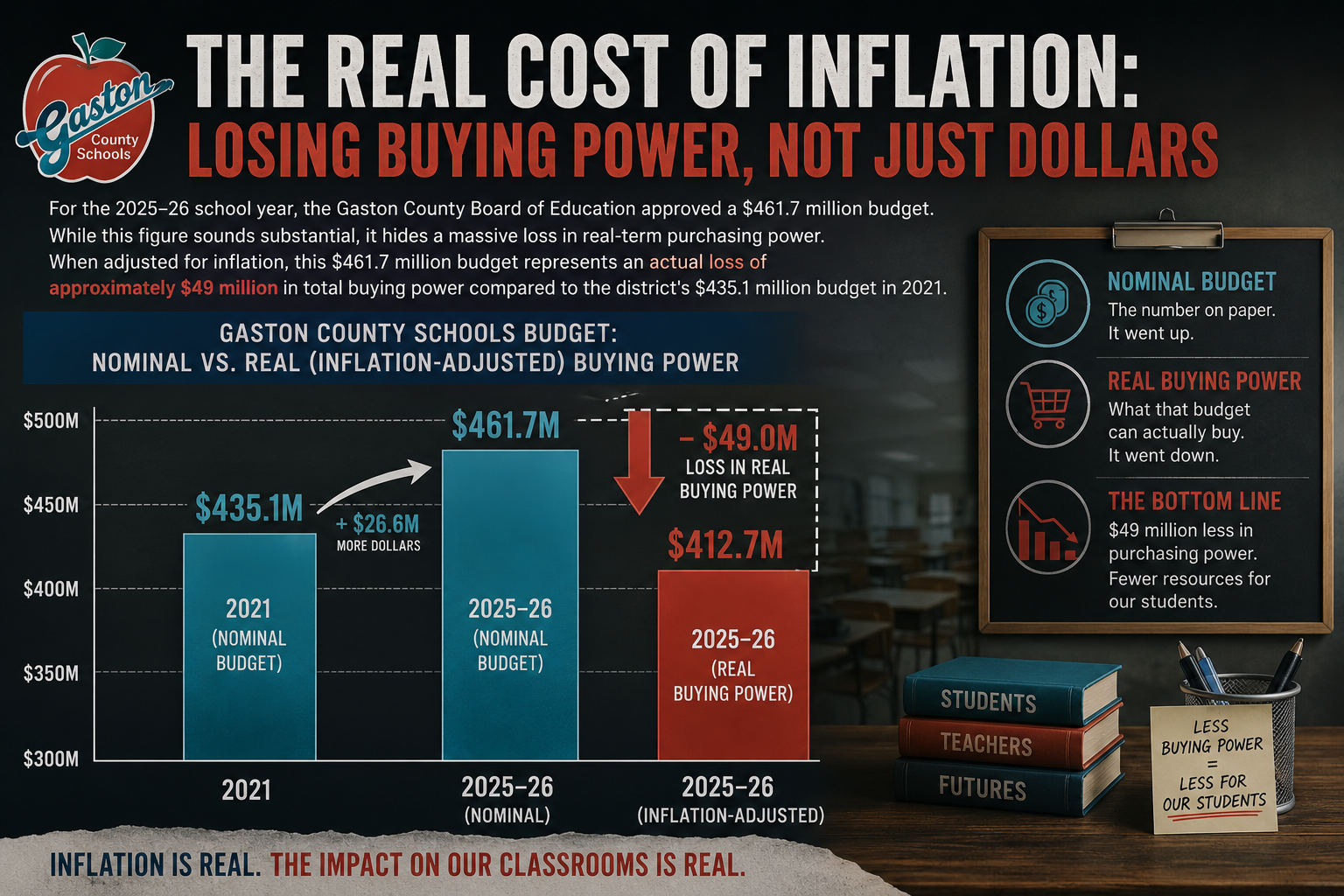
While school systems are forced to pay dramatically more for basic utilities, fuel, instructional technology, and mandatory employee healthcare and retirement benefits, the funding flowing from Raleigh has failed to keep pace. To make matters worse, systemic gridlock in the North Carolina General Assembly meant that for months, local school districts had to operate in a state of deep financial uncertainty without a finalized state budget.
When state funding flatlines amidst historic inflation, it behaves as a silent, regressive tax on public institutions. It forces school boards to do the impossible: absorb skyrocketing operational costs by cutting the very people who make learning possible.
The Trap of the “State Allotment” and Bureaucratic Cruelty
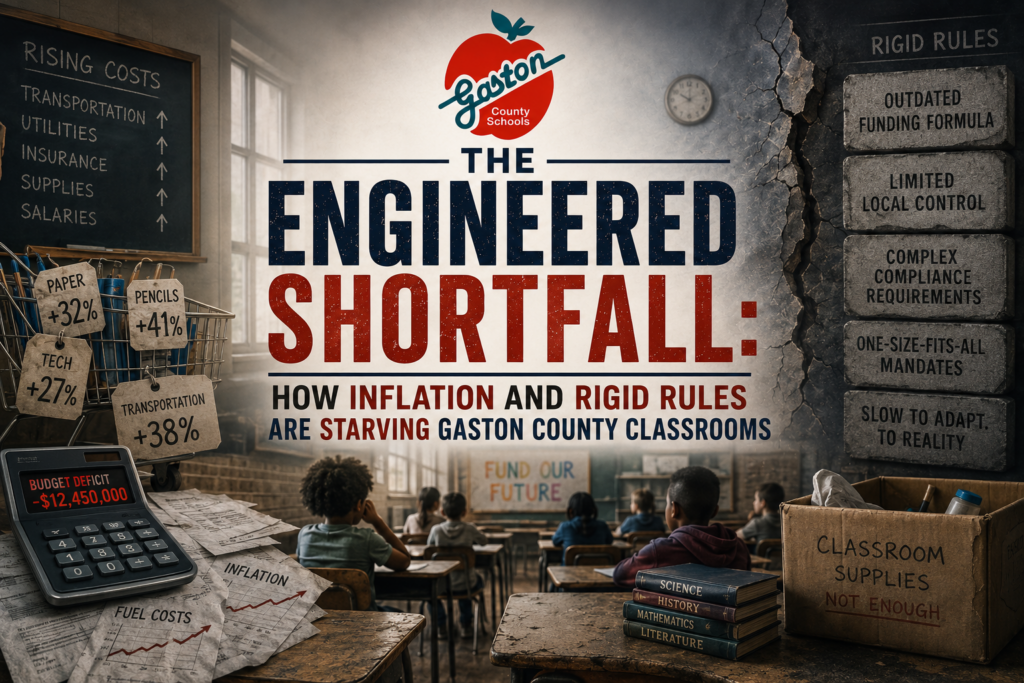
The second claw of this fiscal vice is North Carolina’s rigid “state allotment” system. Under this model, the state funds public schools by allocating specific positions—classroom teachers, principals, counselors, and support staff—based strictly on a mathematical formula tied to Average Daily Membership (ADM).
This formula treats children like standardized units in a factory rather than human beings with complex, individualized needs.
Historically, Gaston County Schools used local county dollars and temporary federal funds to employ extra teachers, nurses, and student support staff beyond what the state allotted. This was a compassionate and necessary choice: with approximately 48% of Gaston County’s campuses designated as high-poverty Title 1 schools, GCS students require intensive, hands-on support.
But as state funding withered and federal pandemic relief funds (ESSER) expired , GCS could no longer afford to subsidize these critical supplemental positions. The rigid state formulas gave the district no flexibility. GCS was forced to structurally realign its staff, leading directly to the elimination of those 83 vital school and district-level positions.
When a school counselor is laid off because of a rigid state ratio, or a classroom is packed with 30 students because the state allotment formula deems it “efficient,” we are witnessing the cold machinery of neoliberal governance at work. It is an approach that values balanced spreadsheets over the emotional and intellectual development of working-class children.
The Progressive Action Plan: How We Fight Back and Reclaim Our Schools
We do not have to accept the managed decline of Gaston County public education. This crisis was created by political choices, which means it can be solved by different political choices. To reverse this structural starvation, progressives must organize around two clear, non-negotiable policy reforms:
1. Mandate Cost-of-Living and Inflation Adjustments for All School Funding
The state of North Carolina must legally bind its education appropriations to the Consumer Price Index (CPI). If inflation rises by 5%, the state education budget must automatically scale by 5%. This simple statutory firewall would stop lawmakers from using inflation to quietly defund public schools while claiming they are supporting “record spending.”
2. Abolish Rigid Position Allotments in Favor of Needs-Based Funding
North Carolina must scrap its outdated, enrollment-only position allotment system. Instead, state funding should be distributed via a weighted, needs-based formula. Schools serving high-poverty neighborhoods (such as Title 1 campuses), high numbers of English language learners, or students requiring exceptional children (EC) services should automatically receive higher funding ratios. Local districts must be given the autonomy to deploy these funds flexibly, hiring the counselors, nurses, and teachers their specific student populations desperately need.
The Bottom Line
The story of Gaston County Schools is a cautionary tale of what happens when we allow state leaders to run public education like a failing business. Our schools are not cost centers to be minimized; they are the heart of our community and the foundation of our democracy.
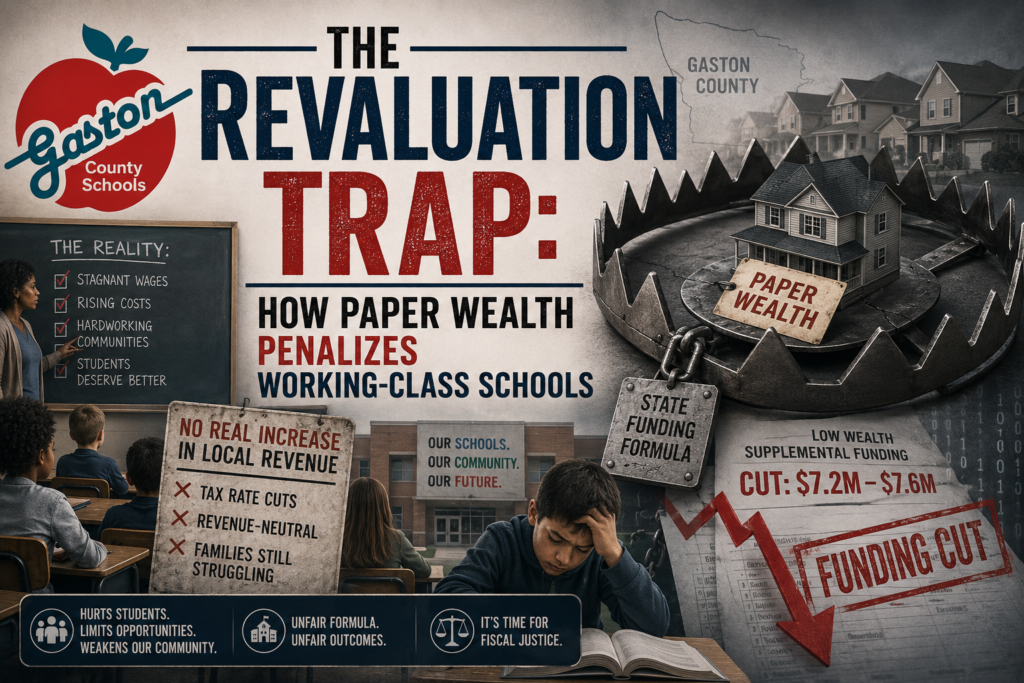
In our next article, we will examine The Revaluation Trap, showing how a sudden spike in Gaston County property values was weaponized by the state to strip GCS of over $7 million in funding—penalizing our children for a real estate bubble they had no part in creating.
Join the fight to protect Gaston County public schools. Share this article, and demand that our local county commissioners and state representatives fund our classrooms, not corporate tax cuts.
Sources & Further Reading
To maintain complete transparency and back up our reporting with hard data, here are the official documents, budget resolutions, and local reporting used to write this article:
Gaston County Schools Finance Department
Overview of Annual Comprehensive Financial Reports and National Financial Reporting Awards (GFOA & ASBO). This document highlights GCS’s long history of fiscal responsibility and excellence awards since 1993 and 1997.
(https://www.gaston.k12.nc.us/departments/finance-department)
Gaston County Schools Board of Education
Official 2025–2026 Annual Budget Resolution. Approved on November 17, 2025, detailing the comprehensive $461,700,000 budget, enrollment shifts (30,616 ADM), and structural alignment measures.
Gaston County Schools HR & Personnel Registry
2025–2026 Budget Information for Employees. This internal guide outlines GCS’s role as Gaston County’s second-largest employer (over 3,800 workers), explains the mechanics of the “state allotment” system, and details why GCS was forced to eliminate 69 school-level and 14 central office positions.
Wise News Network (WNN)
“Gaston County Commissioners Approve $10 Million in Emergency Funding to Prevent Nearly 400 Layoffs” (March 24, 2026). This investigative report details the historic inflation data, the loss of $49 million in real purchasing power since 2021, and the powerful local testimonies of Cramerton Middle School teachers Brittany Elkin and Joshua Winburn.
“Gaston County Schools Suffer the Consequences as Gaston County’s Value Grows” (December 16, 2025). Highlighting the district-wide hiring freeze, rising employee benefit costs, and the fact that 48% of Gaston County campuses operate as high-poverty Title 1 schools.
Ballotpedia: School Districts Database
Gaston County Schools, North Carolina Profile. Historical data outlining the district’s K-12 student-teacher ratios, federal funding declines, and public board meeting minutes.
(https://ballotpedia.org/Gaston_County_Schools,_North_Carolina)