
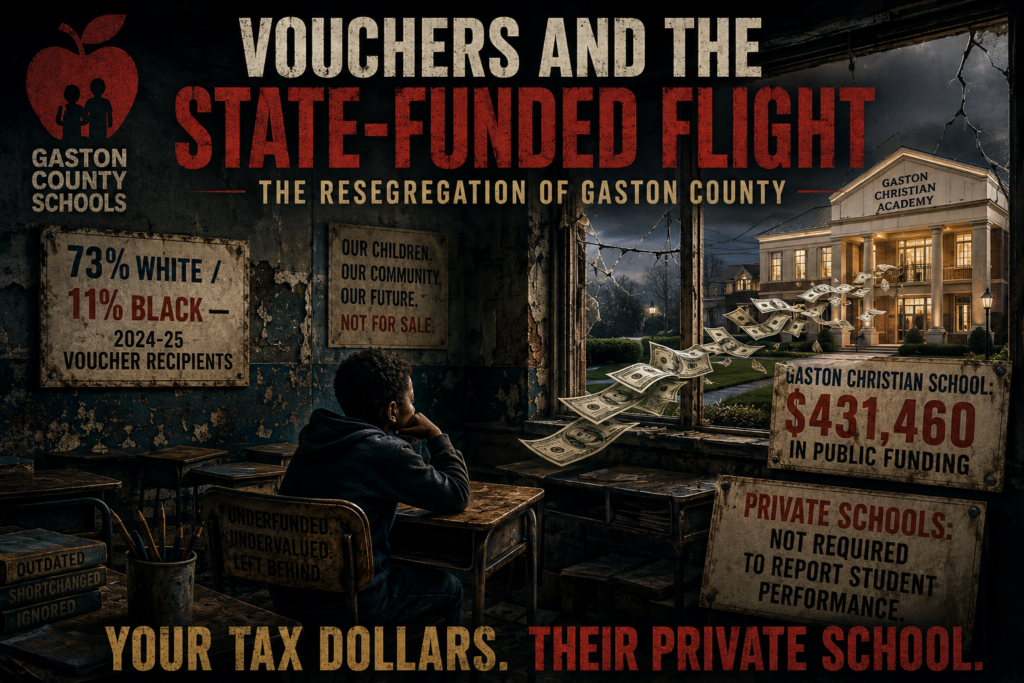
Vouchers and the State-Funded Flight: The Resegregation of Gaston County

Demographic shift chart showing NC school voucher recipients going from 57% White / 23% Black in 2020-21 to 73% White / 11% Black in 2024-25

The modern conservative push for “school choice” is often presented in a progressive wrapper. Proponents argue that taxpayer-funded private school vouchers are a ticket of liberation, allowing low-income minority students to escape underfunded public schools and attend prestigious private academies.

But if you look at the cold, hard data coming out of Raleigh and Gaston County, a much darker reality emerges.

Private school vouchers are not acting as a ladder for the poor; instead, they have been engineered into a regressive wealth transfer system. They function as a state-funded private school discount for affluent, predominantly White families who had already opted out of the public system. By siphoning millions of public dollars into private, unaccountable schools in Gastonia and Bessemer City, this system is driving a severe wave of racial and socioeconomic resegregation.

The Welfare State for the Wealthy

The engine behind this private-school flight is the North Carolina Opportunity Scholarship Program. Initially created in 2014 to assist low-income families , the program was radically transformed in 2023 when the Republican-controlled General Assembly stripped away all family income eligibility requirements and abolished the prerequisite that voucher recipients must have previously attended a public school.

With the click of a legislative pen, a targeted safety net was turned into an unrestricted entitlement program for the wealthy.

According to the most recent May 2026 DPI evaluation of the program, only 12,252 of North Carolina’s 106,704 Opportunity Scholarship recipients—just 11.5%—previously attended a public school. This is only a minor increase from the prior year’s DPI report, which found that an even lower 8.4% of total voucher recipients had transitioned out of public education. In both years, the data confirms that roughly nine out of ten universal voucher recipients were already private school students.

The remaining 88.5% of voucher recipients were students who were already enrolled in private schools. Taxpayers are now directly subsidizing the private tuition bills of wealthy families who never had any intention of sending their children to public schools.

The Sifting Machine: Solving for the “Tuition Gap”

How does this program actively segregate our communities? The answer lies in the math of the private school “Tuition Gap.”

Let G represent the out-of-pocket tuition gap that a family must pay, let T represent the total annual private school tuition and mandatory fees, and let $V$ represent the maximum voucher award granted by the state:

G = T – V


Voucher awards are tiered based on income, ranging from approximately $3,000 to $7,000. Let’s apply this equation to Gaston Christian School, a major private institution in Gastonia.

For high school students (grades 9–12), Gaston Christian charges an annual tuition of $13,478. When you add the mandatory $660 supply fee and the $200 technology fee, the total base cost reaches $14,338.

If a middle-income family qualifies for a Tier 2 voucher of $6,918 , we calculate their Tuition Gap as follows:

G = $14,338 – $6,918 = $7,420

Even with a substantial state voucher, a working-class family is still on the hook for $7,420 out of pocket every single year. This does not include the cost of uniforms, private transportation, or school lunches.

Because low-income and working-class families cannot bridge this gap, elite private schools remain structurally exclusive enclaves. The voucher is essentially useless for poor families, but serves as a generous, taxpayer-funded $7,000 discount check for wealthy families who can easily afford the remaining balance.

Gaston County’s Million-Dollar Siphon

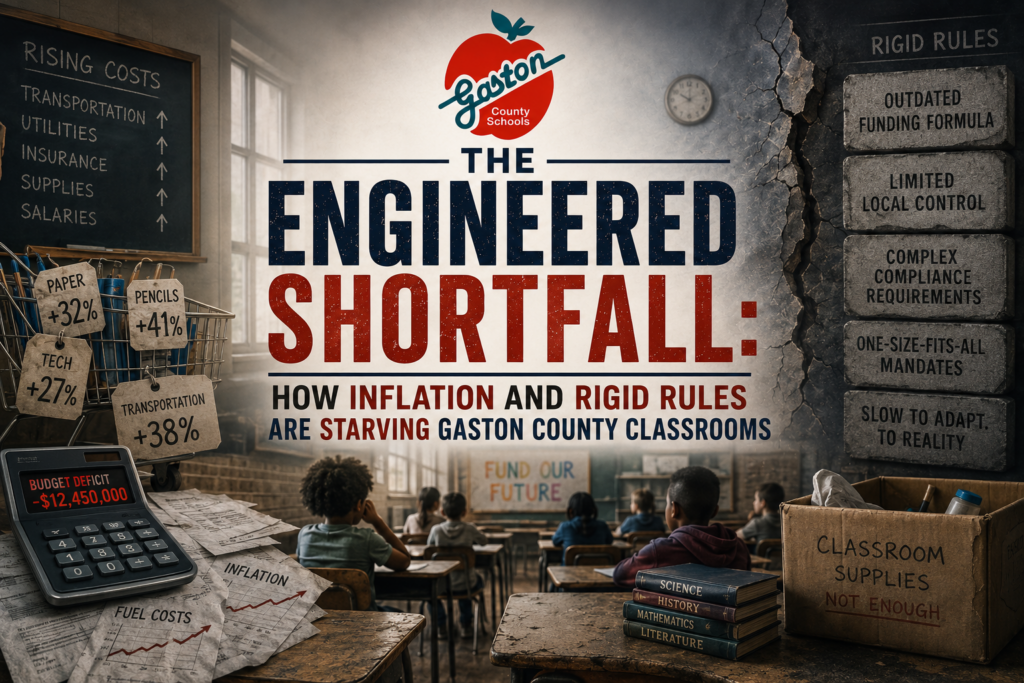
While Gaston County public classrooms are starved by state hiring freezes and position cuts, public tax dollars are flowing in record amounts to private academies.

School / AcademyFY 2023–24 Public FundingFY 2024–25 Public Funding
Community Christian Academy (Bessemer City)$843,695$1,483,447
Gaston Christian School (Gastonia)$893,369$431,460
Gaston Day School (Gastonia)$115,933$236,264

In Bessemer City, Community Christian Academy—a private religious school with a total enrollment of only 276 students—extracted a staggering $1,483,447 in public voucher dollars in a single school year. In Gastonia, Gaston Christian School took in $431,460 (after raking in $893,369 the prior year ).

These millions are being extracted directly from the state’s educational resources—capital that could have been used to hire school nurses, repair Gaston’s crumbling facilities, or raise teacher pay to prevent the district’s severe staffing shortages.

Resegregation and the Accountability Black Hole

This socioeconomic sorting has had a direct, measurable impact on the racial demographics of voucher recipients.

During the early years of the program, when strict income limits were in place, the demographic pool of recipients was relatively diverse. In the 2020–21 school year, 57% of voucher recipients statewide were White, while 23% were Black.

However, after the General Assembly eliminated the income caps, the recipient pool shifted dramatically. By the 2024–25 school year, the demographic makeup of voucher recipients statewide became 73% White and only 11% Black.
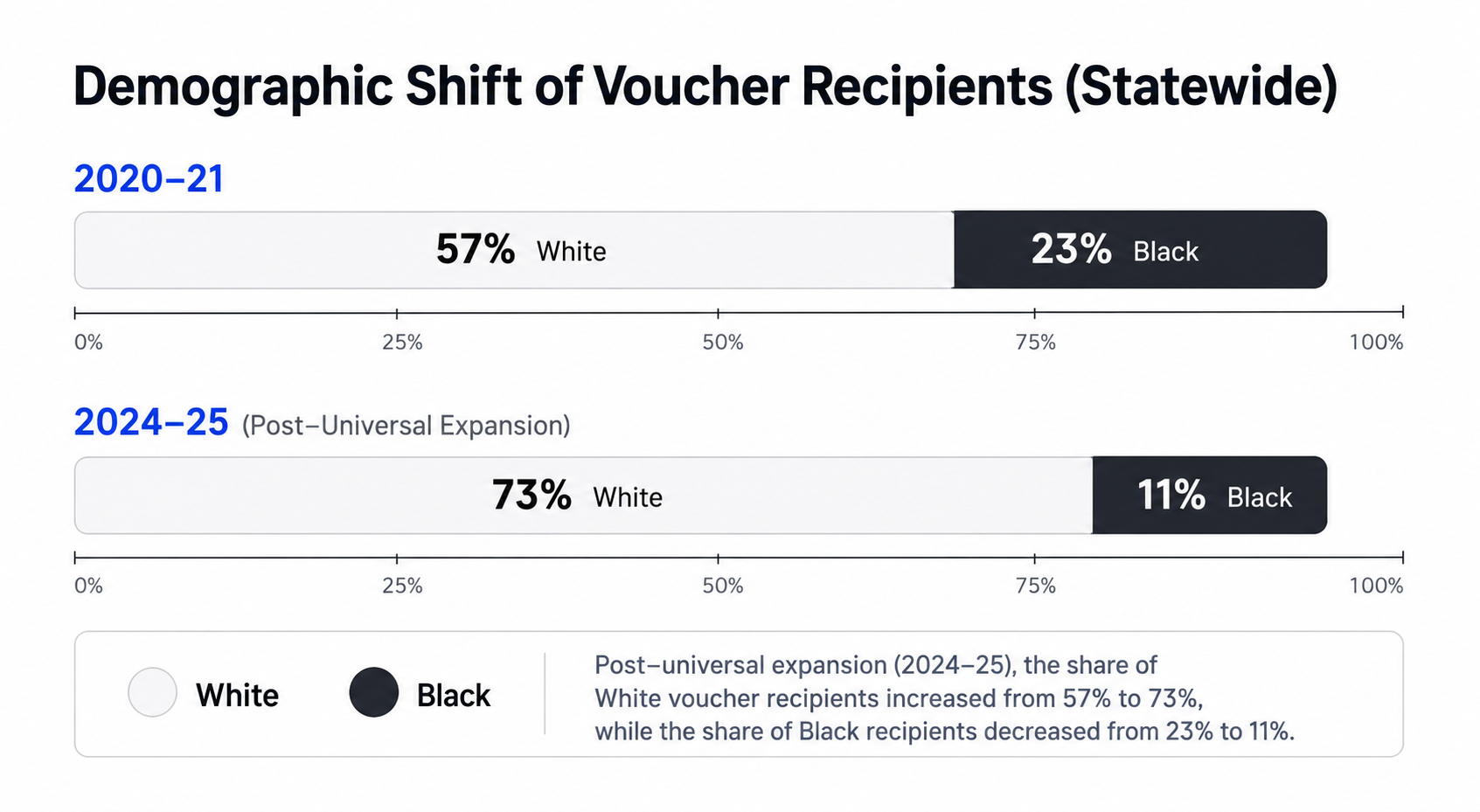
 

The data is clear: public funds are being used to subsidize a whiter, wealthier parallel school system, reversing decades of progress toward integration.

Compounding this moral crisis is a complete lack of accountability. Under North Carolina law, private schools that receive these millions in public voucher funds operate in an absolute black hole. They are:

  • NOT required to hire certified or licensed teachers.

  • NOT required to publicly report student test scores or academic performance.

  • LEGALLY PERMITTED TO DISCRIMINATE against students and families in admissions and employment based on their religion, disability, or LGBTQ+ status.

This lack of civil rights protection has triggered major legal challenges, such as the Kelly v. State lawsuit, which alleges that the Opportunity Scholarship program unlawfully funds systemic discrimination and fails to accomplish any legitimate public purpose.
The Progressive Action Plan: Stopping the Flight

To halt the taxpayer-subsidized segregation of our children and restore equity to K–12 education, we must organize around a clear, progressive reform agenda:

1. Reinstate Strict Income Caps and Public School Prerequisites

We must demand that the legislature immediately restore strict household income limits on all vouchers, ensuring that any public assistance is reserved solely for working-class families. Furthermore, we must reinstate the public school prerequisite: no student should receive a voucher unless they are actively transitioning out of a traditional public school.

2. Mandate Full Civil Rights and Academic Compliance

Any private school that accepts even a single dollar of public voucher funding must be legally required to comply with the same standards as public schools. They must be prohibited from discriminating based on race, religion, sexual orientation, or disability. Additionally, they must employ state-certified teachers and publicly report standardized student performance data so taxpayers can see exactly what their money is buying.

The Bottom Line

The “school choice” movement in North Carolina has built a heavily subsidized, whiter, and wealthier escape hatch that extracts millions from our public classrooms. It is a system that leaves the poorest and most vulnerable students behind in underfunded public buildings while wealthy families cash in on state subsidies.

In our next article, we will examine The Charter Drain, showing how a parallel public-charter system siphons local county tax dollars, leaving Gaston County Schools to manage massive facilities overhead on a hollowed-out budget.

Education is a public good, not a private commodity. Share this article, and demand that our state legislators stop funding private discrimination with public dollars.

Sources & Further Reading

  • North Carolina Department of Public Instruction (NCDPI)

    • Opportunity Scholarship Program Annual Reports & Prior Public School Enrollment Data (May 2026). Detailing that 88.5% of voucher recipients in the expanded program were already enrolled in private schools.

       
  • North Carolina State Education Assistance Authority (NCSEAA)

    • Annual Report on the Opportunity Scholarship Program (October 2024 & October 2025). Providing exact recipient counts and dollar amounts distributed to local private schools, including Community Christian Academy and Gaston Christian School.

       
  • Gaston Christian School Finance Department

    • Gastonia Campus Tuition and Mandatory Fees Schedule (2026–2027). Detailing the $13,478 high school tuition and supplementary fees.

       
  • Public School Forum of North Carolina

    • The Opportunity Scholarship Voucher Expansion: An Analysis of Civil Rights and Financial Accountability Gaps (2024). Explaining the legal exceptions that permit private voucher-recipient schools to discriminate.

       
Scroll to Top