I have been a liberal my whole adult life, which means I have also spent my whole adult life being told that the person I’m about to vote for is a socialist.
Bill Clinton was a socialist because of Hillarycare. Obama was a socialist because of a health insurance plan built on an idea from the conservative Heritage Foundation and test-driven by Mitt Romney in Massachusetts. Every Democrat running for county commission, school board or state house in North Carolina has, at some point, been photoshopped next to a hammer and sickle in a glossy mailer. The word has been worked so hard for so long that it barely means anything anymore except “a Democrat I want you to be afraid of.”
So forgive me if I’ve run out of patience. Because right now, today, the people who have been screaming “socialism” at me for thirty years are running the most government-in-business administration this country has seen outside of wartime. And this week it got personal enough that the President of the United States decided who gets to run the most valuable company in the world.
I don’t want to hear anything else from them about socialism. Not one more word.
The government is now your stockbroker
Let’s start with the boring part, because the boring part is the important part.
In August 2025, the Trump administration took roughly a 10% stake in Intel by converting CHIPS Act grant money into shares. Before that, the Pentagon bought into rare-earth miner MP Materials, roughly a 15% position for $400 million, with a guaranteed price floor on what the company sells. The government took a “golden share” in U.S. Steel that gives Washington a say over the company’s decisions. Then came stakes in Lithium Americas and Trilogy Metals. Then a chip-equipment startup. Then a batch of quantum computing firms.
By this November, a Cato Institute tracker counted federal equity positions of some kind in 41 companies, up from 14 at the start of the year. A Fortune investigation found there isn’t even a central ledger of what the government owns. Nobody can tell you the full size of the portfolio.
And it isn’t just ownership. When Nvidia wanted to sell its H200 AI chips to China, the President announced in December 2025 that the sales could go forward in exchange for a 25% cut to the U.S. government. Think about that for a second. Not a tax passed by Congress. A deal, announced on Truth Social, where the government takes a quarter of a private company’s sales to a foreign rival.
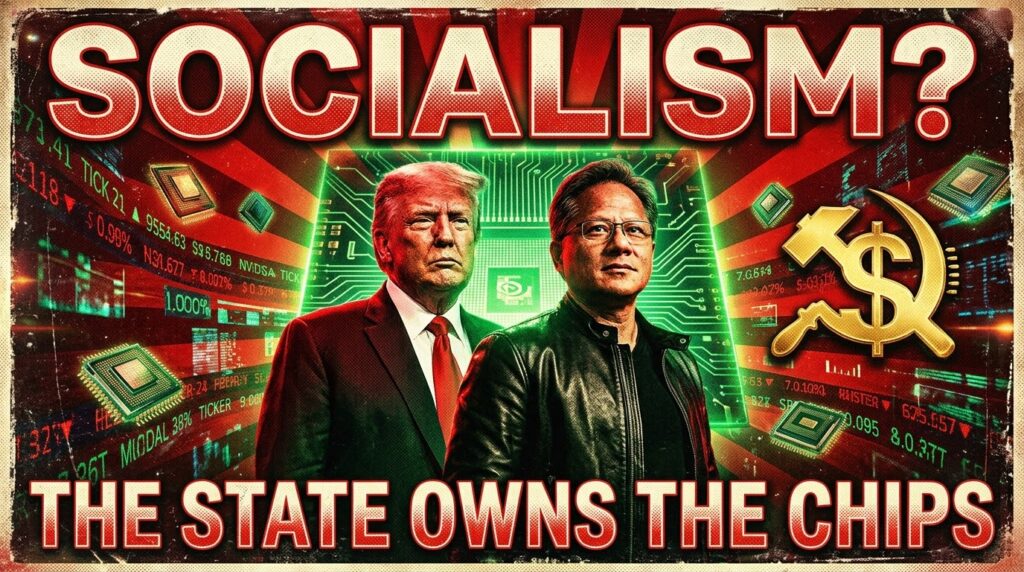
Here’s the thing. Government owning a share of the means of production is pretty much the textbook definition of socialism. That’s not my spin. When the Intel deal was announced, conservative radio host Erick Erickson called it “socialism with an R next to its name.” Rand Paul called it a “terrible idea” and asked whether it was a step toward socialism. National Review ran an editorial telling the government to stay out of the chip business. Commerce Secretary Howard Lutnick had to go on Fox News to insist it was “not socialism.”
When you have to go on Fox to explain that it’s not socialism, it’s socialism.
Except it’s worse than socialism
I want to be fair here, because I think the honest critique is actually sharper than the name-calling.
What we have isn’t really socialism in the way any socialist would recognize it. Socialism, at least the democratic kind, is about ownership that serves the public, run through accountable, transparent institutions. What’s happening now is the opposite. It’s state ownership without the accountability. The government takes stakes in companies, the President picks which ones, and the terms are negotiated in private and announced on social media.
There’s a better word for an economy where political loyalty and personal relationships with the man at the top determine who wins. That word is cronyism. Some economists have been calling it state capitalism. Either way, it’s the thing conservatives used to warn us happened in places like Russia and China.
And it gets more personal than that. According to his own financial disclosures, President Trump personally owns Nvidia stock. At the end of 2025 that stake was reported at somewhere between $12.5 million and $58 million. The Washington Post’s review of later disclosures put it at $13 million to $62 million by the end of August 2026. Analysts have counted more than 100 Nvidia trades in his accounts since he returned to office. A CNN analysis found he promoted more than 20 companies on Truth Social within days of buying their stock. Unlike most modern presidents, he has never put his holdings in a blind trust. The White House says outside firms manage the portfolio independently and that it’s held in a trust run by his children.
Keep that in mind for the next part.
What just happened at Nvidia
Here’s the timeline, based on reporting from NBC News, CNBC, CBS News and the Associated Press over the last two weeks.
On Nov. 8, Nvidia CEO Jensen Huang sent a memo to his staff admitting, in his words, “I was unfaithful to my wife.” Reports described relationships with an Nvidia employee and with Alice Huang, a former executive at Megaspeed, a Singapore-based cloud company. According to The New York Times, as cited by NBC and CBS, U.S. intelligence agencies believed she may have been working with Chinese intelligence. China denies it, and the Justice Department says it hasn’t reached a conclusion. A report about a second Nvidia employee followed. The Times also reported that Secretary of State Marco Rubio had circulated a classified memo back in May about the counterintelligence risk.
Megaspeed is not a side detail. The Justice Department and Commerce Department are investigating whether the company helped divert advanced Nvidia chips to China in violation of U.S. export controls. On Monday, Commerce added Megaspeed to a trade blacklist.
On Nov. 12, Huang resigned. Days later, Nvidia’s board chairman told analysts the board “does not intend to reinstate Jensen as CEO.” Nvidia’s stock dropped more than 25% in a week and dragged the whole market down with it.
Then the White House got involved.
On Monday, Nov. 23, the board unanimously reinstated Huang, effective immediately. Nvidia’s statement said the board “received input from senior levels of the United States government.” The President was a lot less shy about it. In his own words to CNBC and NBC:
- “I convinced them.”
- “I made the deal.”
- “I’ve been speaking to the board directly and indirectly, and I felt very strongly about it.”
- “The board decided to do what we wanted them to do.”
- “Basically, I was represented at the board.”
Asked whether the stock market’s slide influenced him, he said “probably so.” He said Huang “did nothing wrong” and that “we gave them assurances, at least with everything we know.” He also said he hadn’t been told the woman was a suspected spy, which is hard to square with a classified memo his own Secretary of State reportedly circulated six months ago.
The stock jumped more than 30% the day Huang came back. Do the math on what that did for a portfolio holding tens of millions of dollars in Nvidia shares.
I’m not claiming to know what’s in anyone’s heart. Maybe the President genuinely believes Huang is irreplaceable to America’s tech future. But the people raising alarms aren’t just Democrats. Republican Sen. John Cornyn posted, “No national security risk? Based on what?” Republican Rep. Don Bacon said Nvidia should have ignored what he called the administration’s “inexplicable desire to save Huang.” Yale’s Jeffrey Sonnenfeld, who has studied CEOs for decades, called it “a serious erosion of capitalism.”
So let me get this straight. The government takes a 25% cut of a company’s chip sales to China. The President personally owns millions in that company’s stock. The CEO is tied, through an affair, to an executive at a firm under federal investigation for smuggling those same chips to China. The board says it’s done with him. And the President picks up the phone and puts him back.
If a Democratic president did one-tenth of this, the hearings would already be scheduled and the word “socialism” would be the nicest thing they’d say on cable news.
(To be fair, hearings are now scheduled. Congressional committees plan closed-door interviews with Nvidia starting Dec. 1, and Democrats, who take control of both chambers in January, say they intend to dig in.)
So what is “democratic socialism,” actually?
Here’s where the fearmongering really falls apart.
Republicans have spent the last year calling it the “Summer of Socialism” because the Democratic Socialists of America had a good election cycle. DSA-backed candidates won primaries from New York to Colorado to Florida. Zohran Mamdani is mayor of New York City. DSA membership is reportedly over 120,000. A CNN poll this summer found about a third of Democrats now call themselves democratic socialists.
If you believe the ads and the think-tank white papers, these people want breadlines, gulags and the government seizing your truck. So let’s look at what they actually run on.
Mamdani ran on free city buses, universal child care, a rent freeze on stabilized apartments and city-run grocery stores in neighborhoods that don’t have one. Bernie Sanders, the most famous democratic socialist in America, has spent his career pushing for Medicare for All, a higher minimum wage, tuition-free public college and stronger unions. AOC talks about housing, climate and health care.
You can disagree with every single one of those ideas. Plenty of people do, and that’s a fair debate to have. But notice what’s not on the list: one-party rule, abolishing elections, banning churches or jailing journalists. That’s what the word “socialism” in a political ad wants you to picture, and it has nothing to do with these candidates.
The “democratic” in democratic socialism is the whole point. It means you get these things the American way: you win elections, you pass laws and if voters don’t like the results, they vote you out. The authoritarian regimes conservatives love to point to, like the Soviet Union, Cuba and Venezuela, are the opposite. Power was taken or held without consent, and dissent was crushed.
To be honest about it, DSA as an organization does have long-term goals that go further than the average Democrat, including more public and worker ownership of parts of the economy. That’s a real debate worth having in public. But most of what gets labeled “socialism” in American politics is what the rest of the developed world just calls normal. Denmark, Norway, Germany and Canada all have universal health care, strong unions and public transit, plus thriving private companies and stock markets. Economists call that social democracy. We already have pieces of it here. Social Security, Medicare, public schools, public libraries, the interstate highway system and your local fire department. Nobody calls the fire department a gateway to communism.
The double standard is the point
Here’s what bothers me most.
For decades, “socialism” was never really a description. It was a weapon. It was a way to end a conversation about health care or wages or child care before it started. Don’t look at the policy, just be afraid of the word.
Now we have an administration buying stakes in private companies with no central accounting of what it owns, skimming a percentage off a private company’s foreign sales and a President who personally trades the stocks of companies his government is investing in, regulating and, as of this week, staffing. And the same voices who called Obama a Marxist for a marketplace of private insurance plans are mostly quiet, or they’re on TV explaining why this is different.
It isn’t different. It’s worse. Democratic socialists at least tell you what they want to do, put it on a ballot and let you vote on it. What we’re seeing now is the government’s hand on the economy without the democracy part, and with the President’s own portfolio riding along.
So the next time somebody tells me a candidate for city council is a dangerous socialist because she wants the buses to run on time and child care that doesn’t cost more than rent, I’m going to have a question for them.
Where were you when the President picked Nvidia’s CEO?
Until I hear a good answer, I don’t want to hear anything else from them about socialism.
Sources
- PBS NewsHour / AP: Nvidia board unanimously reinstates Jensen Huang
- NBC News: Jensen Huang reinstated as Nvidia CEO after Trump pushes board
- NBC News: Trump says he spoke “directly and indirectly” with Nvidia’s board
- CNBC: Trump sealed deal for Nvidia to rehire Jensen Huang as CEO
- CBS News: Trump says he “convinced” Nvidia board to reinstate Huang
- Nvidia Form 8-K, Nov. 23, 2026: SEC filing
- MLQ (Cato tracker): The US government now holds stakes in 41 companies
- Benzinga: Trump administration stakes in public companies
- Al Jazeera: Trump clears way for sale of Nvidia H200 chips to China
- Fortune: What is socialism? Intel, Trump and the GOP reaction
- Tom’s Hardware: GOP senators question Intel stake; critics call it socialism
- The Next Web / CNBC: Trump’s accounts traded up to $97.5M in Nvidia stock
- Philadelphia Inquirer / Washington Post: Trump’s Nvidia stock holdings
- CNN: Trump promoted companies on Truth Social days after buying their stocks
- TIME: Inside the DSA’s push to remake the Democratic Party
- CNN: Democratic socialists strategize for their biggest moment yet
- Brookings: Democratic socialist candidates show gains but limited reach in 2026