Who Funds Our Schools? A Primer on the Gaston County Budget Crisis
In North Carolina, public school funding relies on a tripartite structure: federal, state, and local revenues. With federal emergency pandemic funds (ESSER) completely expiring, the survival of Gaston County Schools (GCS) rests entirely in the hands of two governing bodies: The North Carolina General Assembly (The State) and The Gaston County Board of County Commissioners (The County).
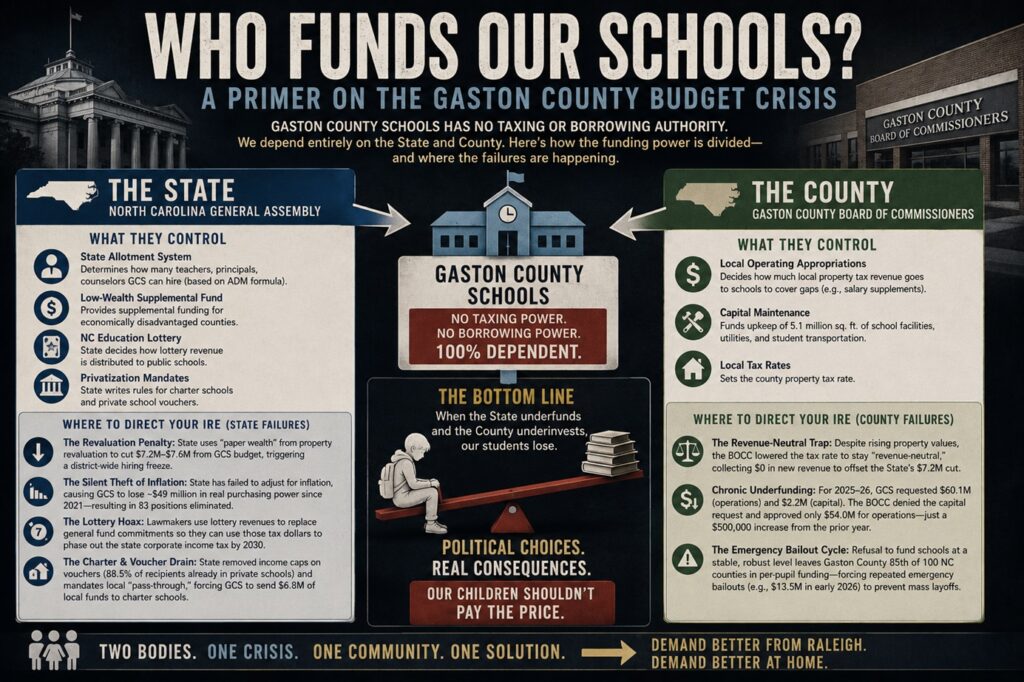
Because the GCS Board of Education has no independent tax-levying or borrowing authority, they are completely dependent on the state and county to survive. Here is exactly how the power is divided, and where the blame belongs.
1. The State’s Role (The North Carolina General Assembly)
The state is constitutionally obligated to provide a “sound basic education,” which means they are primarily responsible for funding core instructional personnel.
What They Control:
- The “State Allotment” System: The state dictates exactly how many teachers, principals, and counselors GCS can hire based strictly on a rigid mathematical formula tied to Average Daily Membership (ADM).
- The Low-Wealth Supplemental Fund: The state controls supplemental funding designed to help economically disadvantaged counties.
- The NC Education Lottery: The state controls how lottery revenues are distributed to public schools.
- Privatization Mandates: The state writes the rules governing charter schools and private school vouchers.
Where to Direct Your Ire (The State’s Failures):
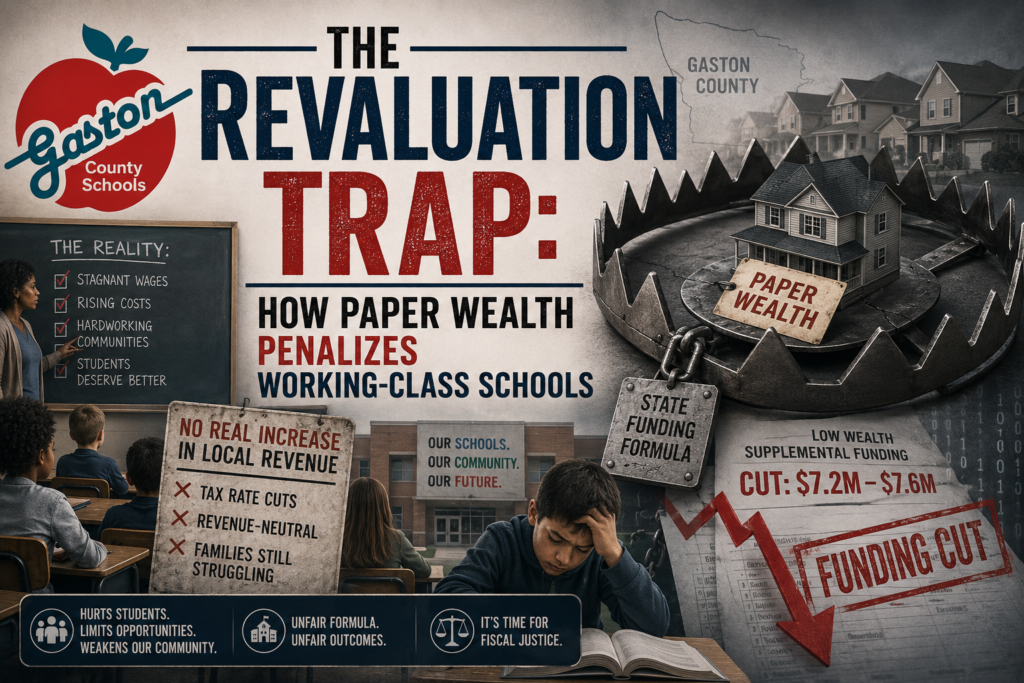
- The Revaluation Penalty: Because the state calculates a county’s “wealth” based on paper real estate values rather than actual household income, the state used Gaston County’s recent property revaluation to justify slashing $7.2 million to $7.6 million from GCS’s budget, triggering a district-wide hiring freeze.
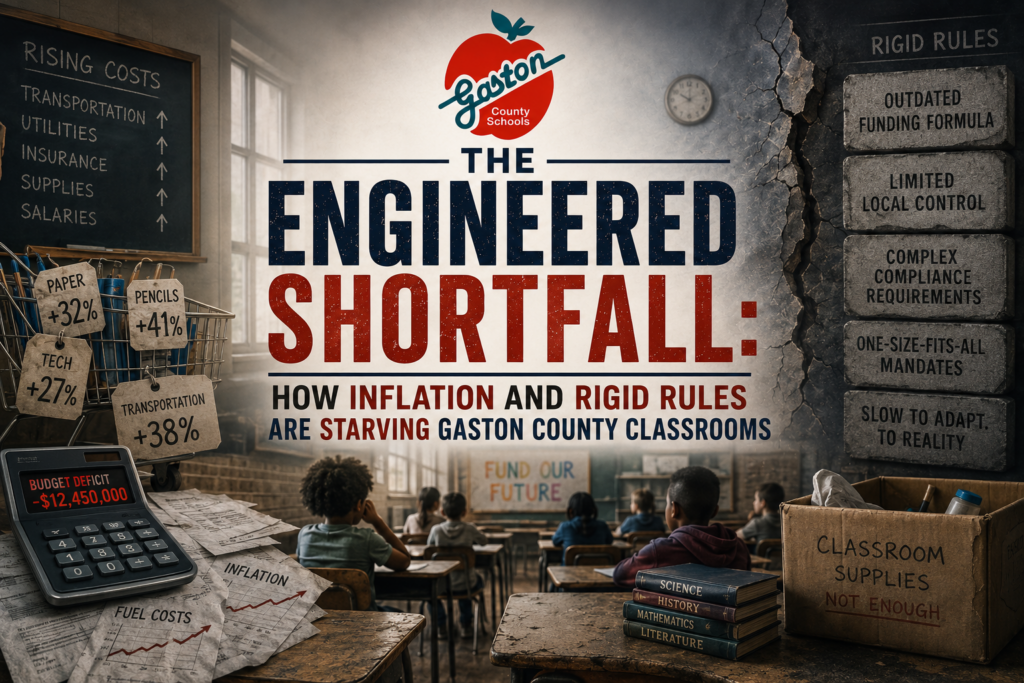
- The Silent Theft of Inflation: The state has failed to adjust its funding for inflation, causing GCS to lose roughly $49 million in real purchasing power since 2021. This flatlining forced GCS to eliminate 83 vital school and district-level positions.
- The Lottery Hoax: State lawmakers have systematically used growing lottery revenues to supplant (replace) general fund commitments. They use lottery money to pay for basic school needs so they can use general tax dollars to aggressively phase out the state corporate income tax by 2030.
- The Charter & Voucher Drain: The General Assembly removed income caps on vouchers, transforming them into a wealth subsidy where 88.5% of recipients statewide were already in private schools. Furthermore, state law mandates the local “pass-through,” forcing GCS to hand over $6.8 million of its limited local funding directly to charter schools.
2. The County’s Role (Gaston County Board of Commissioners – BOCC)
While the state is supposed to pay for instruction, the local county commissioners are responsible for funding the physical infrastructure and providing supplemental operating cash.
What They Control:
- Local Operating Appropriations: The BOCC decides how much local property tax revenue goes to the school system to cover critical gaps the state ignores, such as local teacher salary supplements.
- Capital Maintenance: The county is entirely responsible for funding the upkeep of GCS’s 5.1 million square feet of aging school facilities, as well as paying for utility expenses and student transportation routes.
- Local Tax Rates: The BOCC sets the county property tax rate.
Where to Direct Your Ire (The County’s Failures):
- The Revenue-Neutral Trap: When property values spiked, the BOCC chose to drop the county tax rate to remain strictly “revenue-neutral”. By doing this, the county collected zero new revenue to offset the massive $7.2 million cut handed down by the state, leaving the schools holding the bag.
- Chronic Underfunding: For the 2025–26 fiscal year, GCS requested $60.1 million for operations and $2.2 million for capital maintenance. The BOCC denied the capital request entirely and approved only $54.0 million for operations—a measly $500,000 increase from the year before.
- The Emergency Bailout Cycle: Because the BOCC refuses to establish a stable, robust local funding baseline for our schools, Gaston County ranks 85th out of 100 NC counties in per-pupil funding. This chronic starvation forces educators to repeatedly beg the BOCC for short-term emergency bailouts (like the $13.5 million approved in early 2026) just to prevent mass layoffs mid-year.
Sources & Further Reading
Gaston County Schools Board of Education
- Official 2025–2026 Annual Budget Resolution. Approved November 17, 2025. This document details the district’s comprehensive $461.7 million budget, the $7.2 million to $7.6 million Low Wealth Counties Supplemental funding reduction triggered by the revaluation penalty, and the mandatory $6.8 million charter school pass-through.
- Link: https://resources.finalsite.net/images/v1763488347/gastonk12ncus/bjlh8jhteo1sh8orpzxe/AnnualBudget.pdf
Gaston County Schools HR & Personnel Registry
- 2025–2026 Budget Information for Employees. Outlines the mechanics of the “state allotment” system and the resulting structural alignment that forced GCS to eliminate 83 vital school and district-level positions.
- Link: https://www.gaston.k12.nc.us/departments/finance-department/annual-budget/2026-2027/budget-information-for-employees
Wise News Network (WNN)
- “Gaston County Commissioners Approve $10 Million in Emergency Funding to Prevent Nearly 400 Layoffs” (March 24, 2026). Investigative report detailing the historic inflation data, the loss of $49 million in real purchasing power since 2021, and the $13.5 million total emergency bailouts from the County Commissioners.
- Link: https://wisenewsnetwork.com/stories/gaston-county-commissioners-approve-10-million-in-emergency-funding-to-prevent-nearly-400-layoffs,4914
- “Gaston County Schools Suffer the Consequences as Gaston County’s Value Grows” (December 16, 2025). Details the property revaluation metrics, the revenue-neutral trap, and the district-wide hiring freeze.
- Link: https://wisenewsnetwork.com/stories/gaston-county-schools-suffer-the-consequences-as-gaston-countys-value-grows,4534
EducationNC (EdNC)
- “North Carolina Education Lottery Revenue Up, But Less Money Went to Schools” (January 21, 2026). Details the state audit confirming the “Lottery Hoax,” revealing that as lottery revenue grew by over $1 billion, the actual net dollar amount distributed to public classrooms declined.
- “Property Tax Limits and State-Level Revenue Declines Strain Tight School Budgets” (2025). Discusses the planned complete phase-out of North Carolina’s corporate income tax by 2030.
Public School Forum of North Carolina
- Local School Finance Study & Per-Pupil Spending Reports. Validates the chronic underfunding issue, highlighting that Gaston County currently ranks 85th out of 100 North Carolina counties in local per-pupil funding.
North Carolina General Assembly (NCGA)
- North Carolina General Statutes § 115C-218 and § 115C-562.1. Explains the formulas used to calculate Low-Wealth Supplemental Funding Eligibility (wealth-based school allotments relying on property valuation ratios) and the local non-supplanting requirements.