When proponents of the neoliberal education reform movement talk about public charter schools, they rely on a highly polished, market-driven vocabulary. They speak of “educational laboratories,” “competitive pressure,” and “liberating choice.” In theory, charter schools—which are publicly funded but privately operated by independent non-profit boards—are supposed to force traditional public school systems to “up their game” by competing for students.
But if you look past the corporate buzzwords and examine the structural reality in Gaston County, a far more predatory economic model emerges.
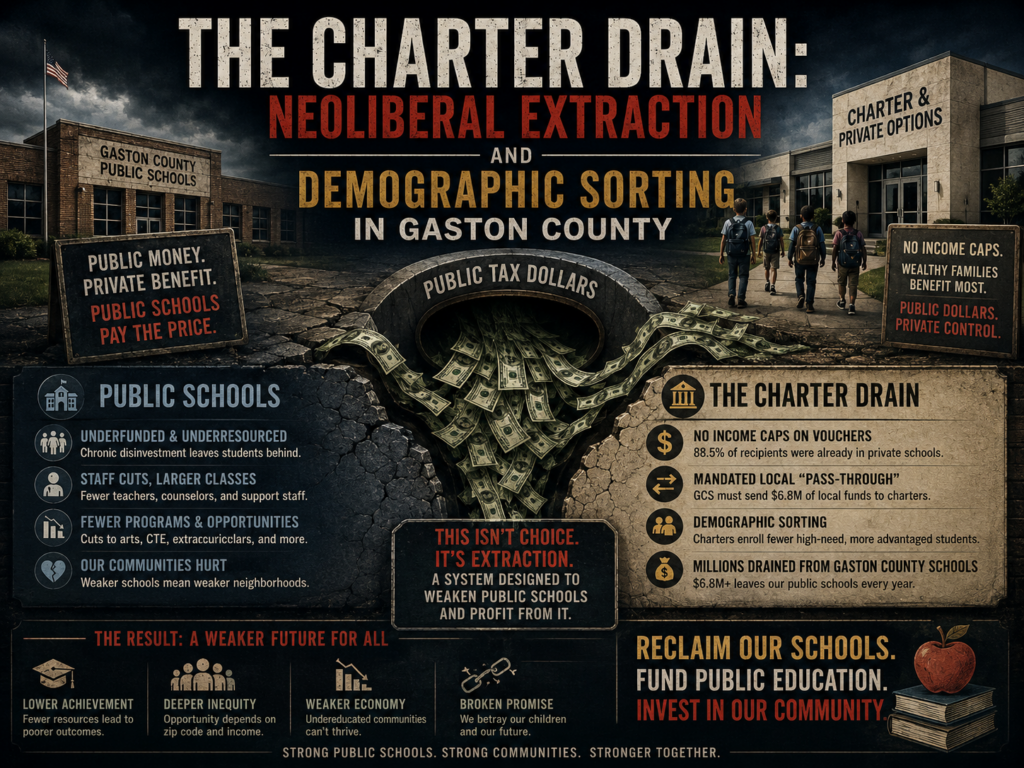
Far from acting as benign “laboratories of innovation,” the charter school sector in Gaston County operates as a double-edged mechanism of neoliberal extraction and demographic sorting. It systematically drains critical operating capital from traditional classrooms while quietly sorting our children along lines of race and class, turning the promise of a unified public education system into a fragmented marketplace.
The Mechanics of Neoliberal Extraction
To understand how charter schools hollow out our local public classrooms, we must look at the hidden mechanics of county school funding.
Gaston County has no independent tax-levying authority; it relies entirely on the Gaston County Board of County Commissioners (BOCC) for its local operating expenses. For the 2025–26 fiscal year, the county commissioners allocated a local operating budget of $54.0 million to Gaston County Schools (GCS)—a flatlined budget representing an increase of only $500,000 from the prior year.
But GCS did not actually get to spend that $54.0 million on its own students. Under North Carolina law, when a local student enrolls in a charter school, the traditional school district is legally mandated to remit a proportional “pass-through” share of its county operating funds directly to that charter school.
We can model this local budget hollowing using a simple formula. Let L_net represent the net local operating funds available to GCS, let L_app represent the total county appropriation, and let C_pass represent the mandated charter pass-through:
L_net = L_app − C_pass
For Gaston County Schools, this equation reveals a devastating fiscal extraction:
L_net = $54,000,000 − $6,800,000 = $47,200,000
State law forced GCS to hand over $6.8 million of its limited local budget directly to various charter schools.
This pass-through mandate creates an asymmetric liability for traditional public schools. Traditional school systems operate under massive economies of scale and carry enormous fixed liabilities. GCS must maintain and operate 5.1 million square feet of aging facility space, run dozens of yellow bus routes, pay utility bills, and keep building administrators on payroll.
When a student leaves a public school for a charter, the GCS budget loses that student’s local funding. However, GCS’s fixed liabilities do not decrease: you cannot lay off 1/30th of a bus driver, turn off 1/30th of the lights in a classroom, or cut 1/30th of a roof repair bill. Traditional public schools are left holding the bill for massive physical overhead on a deeply hollowed-out operating budget.
The Resegregation Effect: The Dual Sorting Process
Who is actually benefiting from this siphoned capital? To answer this, we must examine the demographic sorting process.
A landmark longitudinal study by Duke University researchers Helen Ladd and Robert Bifulco tracked North Carolina charter school trends over a decade. They discovered a stark, statewide trend: charter schools in North Carolina have transitioned from serving a disproportionate share of minority students to serving an increasingly White, socioeconomically advantaged student population.
This state-level demographic sorting is vividly apparent in Gastonia:
| Entity | White (%) | Black (%) | Hispanic (%) |
| Gastonia City Limits (2020 Census) | 50.8% | 30.3% | 12.7% |
| Gaston County Schools (LEA) | 42.5% | 25.8% | 23.2% |
| Piedmont Community Charter School | 52.7% | 18.3% | 20.6% |
Sources: Gastonia City Limits , Gaston County Schools LEA, Piedmont Community Charter
Notice the sharp discrepancy: Gastonia’s city population is more than 30% Black , and the traditional Gaston County Schools public LEA is 25.8% Black. Yet, Piedmont Community Charter School—the largest charter school in Gastonia—enrolls a student body that is 52.7% White and only 18.3% Black.
This is what progressive scholars call racial and socioeconomic hoarding. Well-resourced, academically stable charter schools attract disproportionately White, middle-class families. These institutions are public in name, but because they are not legally mandated to provide free yellow bus transportation or participate in the National School Lunch Program, they are structurally designed to exclude working-class children of color.
The Sacrifice Zone: The Collapse of High-Poverty Charters
The second half of the double segregation effect is the concentration of poverty in under-resourced charters that target low-income minority communities. In a completely deregulated educational marketplace, these schools are often abandoned to fail.
A devastating local example of this is Ridgeview Charter School in Gastonia. Ridgeview was a K–9 charter school specifically established to serve some of Gaston County’s poorest and most vulnerable minority children.
But under the charter model, which strips schools of central office support and leaves them to survive on flatlined per-pupil dollars, Ridgeview entered a spiral of academic distress. State evaluations revealed that Ridgeview’s overall student proficiency was a shocking 36 percentage points below the Gaston County Schools average, and the school repeatedly failed to meet basic academic growth targets.
Consequently, in early 2026, the state Charter Schools Review Board voted unanimously not to renew Ridgeview’s charter, cutting off its funding and forcing its immediate closure.
While charter proponents point to the closure of failing schools as “market efficiency,” they completely ignore the human cost. When a high-poverty charter like Ridgeview collapses, those low-income minority students do not disappear. They are thrust back into traditional GCS public schools mid-year.
Gaston County Schools is expected to absorb these students, provide immediate remediation, and manage their complex needs. GCS must do this even though its local operating funds have already been systematically depleted by charter pass-throughs, state property revaluation penalties, and universal private school vouchers.
The Progressive Action Plan: Ending the Capital Drain
We do not have to allow our public education system to be carved up and privatized. To protect traditional Gaston County public schools and stop the demographic sorting of our children, we must organize around a bold, progressive policy agenda:
1. Abolish the Local Funding “Pass-Through” Mandate
If charter schools wish to operate as independent entities, they must be funded directly from state-level appropriations. The local county “pass-through” mandate must be abolished immediately. Traditional public school systems must retain 100% of their local county tax allocations so they can maintain the massive physical infrastructure and facilities overhead required to serve the entire community.
2. Mandate Full Demographic Parity and Structural Access
To retain a state charter, all charter schools must be legally required to reflect the racial and socioeconomic demographics of the school district in which they reside within a 5% margin of error. Additionally, the state must mandate that charter schools provide identical support services as traditional public schools—including free student transportation and the National School Lunch Program—to ensure that low-income and minority students are not structurally locked out of these taxpayer-funded institutions.
The Bottom Line
The charter school experiment in Gaston County is not delivering “innovation” to the public sector. Instead, it is performing a classic neoliberal extraction: privatizing the enrollment of lower-overhead, middle-class students while socialising the massive liabilities of facility maintenance and high-need student remediation back onto a starved public school system.
In our final article, we will examine Organizing for Democratic Control, analyzing how the conservative courts have abandoned our children by dismantling thirty years of Leandro equity rulings, and how a grassroots political rebellion is rising in Gaston County to take our classrooms back.
Our communities deserve unified, integrated schools, not a divided marketplace. Share this article, and demand that our local and state leaders protect public education from the charter drain.
Sources & Further Reading
Duke University Sanford School of Public Policy
“Evaluating Charter Schools in North Carolina: Racial Balance, Student Churn, and Academic Trajectories” by Helen Ladd and Robert Bifulco. Detailing the longitudinal study on charter-school resegregation trends in NC.
North Carolina Department of Public Instruction (NCDPI)
Piedmont Community Charter School Demographics & Test Scores Report (2025–2026). Detailing the 52.7% White, 18.3% Black, and 20.6% Hispanic enrollment split.
Gaston County Schools LEA Student Demographics and Ethnic Distribution data (2025–2026).
The Assembly NC / WFAE News
“State Charter Schools Review Board Declines to Renew Charter of Gastonia’s Ridgeview Charter School” (April 2026). Coverage of the unanimous state vote to close the Gastonia charter due to proficiency rates falling 36 percentage points below the GCS average.
Gaston County Schools Finance Department
Official 2025–2026 Annual Budget Resolution. Detailing the $6.8 million charter pass-through and GCS’s 5.1 million square feet facilities footprint.