It is the single most common defense used by proponents of school privatization: “But charter schools are public schools!”
On the surface, the claim seems open and shut. Charter schools are funded by taxpayer dollars, they do not charge tuition, and they are legally prohibited from discriminating in admissions or being religious in their operations.
But to a political scientist analyzing the legal, economic, and structural architecture of K–12 education, this talking point is a massive sleight of hand. Calling a charter school “public” simply because it receives public tax dollars is like calling a private defense contractor a “public company” because its entire revenue stream comes from the Pentagon.
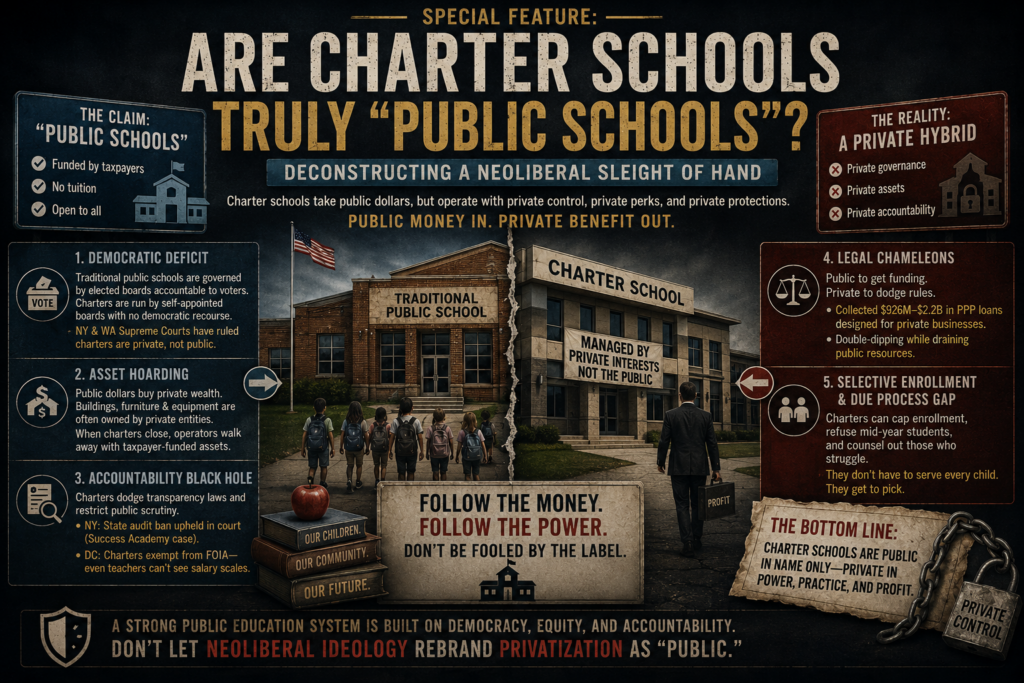
If we look past the marketing and examine the structural reality, charter schools behave as privately managed hybrids. They are public when it comes to extracting taxpayer funds, but private when it comes to asset ownership, democratic governance, transparency, and legal liability.
1. The Democratic Deficit: Private Governance vs. Elected Boards
The most fundamental characteristic of a truly public institution is democratic accountability. Traditional public school districts are governed by boards of education whose members are elected by—and directly accountable to—the voting taxpayers of the community.
Charter schools, by contrast, are governed by self-appointed, self-perpetuating private boards. If parents, teachers, or local taxpayers are unhappy with how a charter school spends its money or treats its students, they have no democratic recourse. They cannot vote the board members out of office.
This democratic deficit is not just a theoretical complaint; it is a legal reality. The Supreme Courts of both New York State and Washington State have ruled that charter schools are actually private schools because they fail the minimum test for being genuine public entities: they are not run by school boards elected by, and under the control of, voting citizens.
2. Asset Hoarding: Taxpayer-Funded Private Wealth
In a traditional public school system, every dollar spent on a building, a desk, or a computer remains a public asset. If a public school closes, those assets are retained by the public school district for the benefit of the taxpayers.
In the charter school sector, public tax dollars are routinely used to build private wealth. Charter school buildings and land are frequently owned by the charter’s founders, a private trust, or an affiliated private company. The school’s rent or mortgage is paid for entirely with taxpayer money, yet the private entity retains ownership of the real estate.
Furthermore, in schools run by private Education Management Organizations (EMOs), the school’s furniture, computers, and books are often owned by the EMO and leased back to the school at taxpayer expense.
When a charter school collapses—as Gastonia’s high-poverty Ridgeview Charter School did in 2026 due to academic failure —the private operators frequently walk away with the buildings, supplies, and equipment purchased with public funds. Public wealth is systematically converted into private equity.
3. The Accountability Black Hole
Traditional public schools operate under strict sunshine laws, public records requirements, and state-level financial oversight. Charter schools, however, have built-in legal shields to dodge this transparency.
Because they are operated by private boards or EMOs, charter schools have very narrow reporting requirements and can restrict public scrutiny. Consider these stark examples of charter school secrecy:
The Audit Ban: In 2014, when the New York State Controller attempted to audit the financial books of Eva Moskowitz’s Success Academy, the charter leader took the state to court and won, legally barring the state from investigating how public tax dollars were spent.
The Salary Shield: When the City Paper attempted to report on the salaries of charter teachers and administrators in Washington, D.C., they discovered that charter schools are exempt from the Freedom of Information Act (FOIA). In fact, charter teachers themselves were legally barred from seeing the salary scale for their own jobs.
4. Legal Chameleons: Double-Dipping on Private Perks
Charter schools are master legal chameleons. When they are lobbying state legislatures for funding, they claim they are “public schools”. But in courtrooms and federal programs, they pivot to claiming private status to evade statutory regulations and access private benefits.
This hypocrisy was on full display during the COVID-19 pandemic. An analysis by the Network for Public Education found that charter schools and their private management companies successfully secured between $926 million and $2.2 billion in federal Paycheck Protection Program (PPP) loans.
PPP loans were strictly designed for private small businesses and non-profits to stay afloat; traditional public schools were legally ineligible. Charters successfully claimed they were private entities to pocket billions in PPP loans, all while continuing to collect 100% of their state-allotted public per-pupil funding.
5. Selective Enrollment and the Due Process Gap
A true public school is bound by a universal mandate: it must serve every child who lives in its district. Traditional public schools cannot turn students away, they must accept high-need students mid-year, and they must provide robust due process protections.
Charter schools operate under entirely different rules:
No Mid-Year Backfilling: Unlike public schools, charters can cap their enrollment slots. They do not have to accept students mid-year, meaning they can easily “weed out” struggling students and refuse to fill their empty seats.
The Expulsion Loophole: Charter schools do not have to follow the same due process rules for students and staff. In California, an appeals court ruled that a 14-year-old student expelled from a charter school was not entitled to a disciplinary hearing to present evidence in his defense—a basic constitutional right guaranteed to every traditional public school student.
The Staffing Loophole: In North Carolina, charter schools are exempt from hiring fully licensed educators; only 50% of their classroom teachers are required to hold a state teaching license.
The Bottom Line
Calling charter schools “public schools” is an incredibly effective public relations campaign, but it is a structural lie. In reality, they are private organizations funded by public tax dollars to run parallel, unaccountable school systems that siphon resources from our democratically controlled classrooms.
If we want to build a truly equitable education system in Gaston County, we must reject the market logic of privatization and demand a return to democratic control: where public funds stay in public hands, governed by public boards elected by the public people.
Sources & Further Reading
The Network for Public Education (NPE)
Are Charter Schools Truly Public Schools? An Analysis of Private Governance, Asset Ownership, and Accountability Gaps (2021). Detailed brief on the legal status of charter schools, including the California appeals court and Washington State Supreme Court rulings.
Diane Ravitch / Peter Greene
“Charter Schools Are Not Public Schools” (January 2023). Detailing the DC teacher salary secrecy and the Success Academy lawsuit barring public audits.
North Carolina General Statutes
N.C.G.S. § 115C-218 (North Carolina Charter School Act). Detailing the exemption of charter schools from traditional public school regulations, including the 50% teacher licensing loophole.