
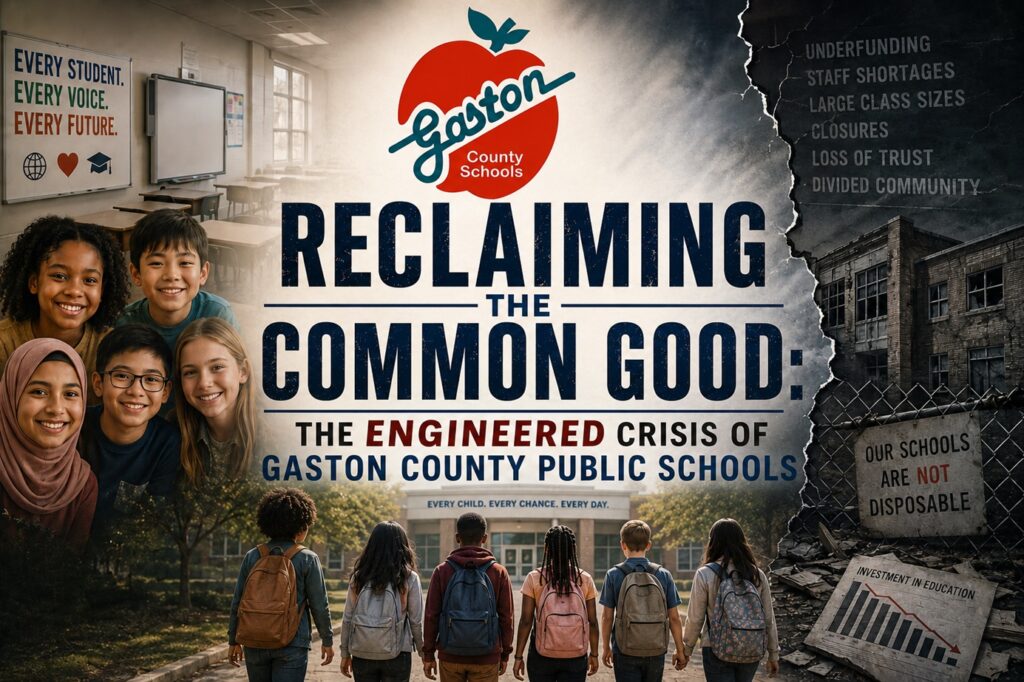
Welcome to Reclaiming the Common Good, a 6-part investigative series exploring the systematic dismantling, underfunding, and demographic sorting of public education in Gaston County, North Carolina.
For decades, public schools were celebrated as the cornerstone of our local communities—places where children from all walks of life could access opportunity, and where dedicated public servants were given the resources to help them thrive. Today, Gaston County Schools (GCS)—the county’s second-largest employer—is operating in a state of manufactured crisis. From sudden multi-million-dollar state funding penalties to the rapid diversion of public tax dollars into private and charter systems, the challenges facing our classrooms are not accidental. They are the direct result of deliberate political and economic choices.
This series pulls back the curtain on the corporate tax-cut agenda, the privatization schemes, and the structural loopholes that are starving our schools. More importantly, it provides a progressive roadmap for how we, as a community, can organize, fight back, and reclaim our public schools as a vibrant public good.
The Road Map: Explore the Series
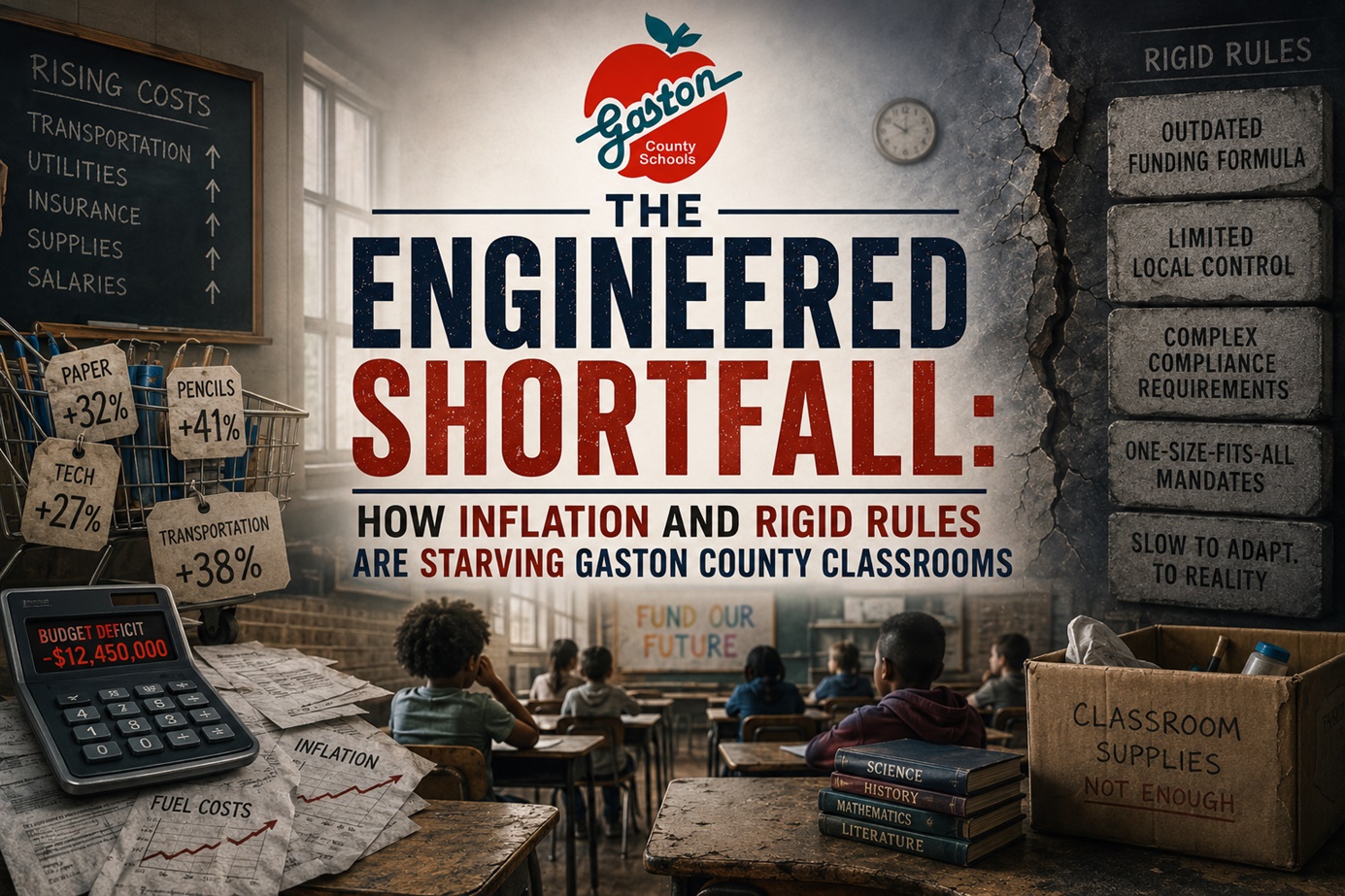
The Engineered Shortfall: How Inflation and Rigid Rules Are Starving Gaston County Classrooms
The Focus: The illusion of “record funding” and the rigid state formulas that treat children like standardized units on a spreadsheet.
What We Cover: How inflation has quietly stripped Gaston County Schools of approximately $49,000,000 in actual purchasing power since 2021, and how a rigid, enrollment-based “state allotment” system forced the district to eliminate 69 school-level educator positions and 14 central office positions before the school year even began.
The Progressive Action: Legally binding state education funding to the Consumer Price Index (CPI) and transitioning to a needs-based, weighted staffing model.
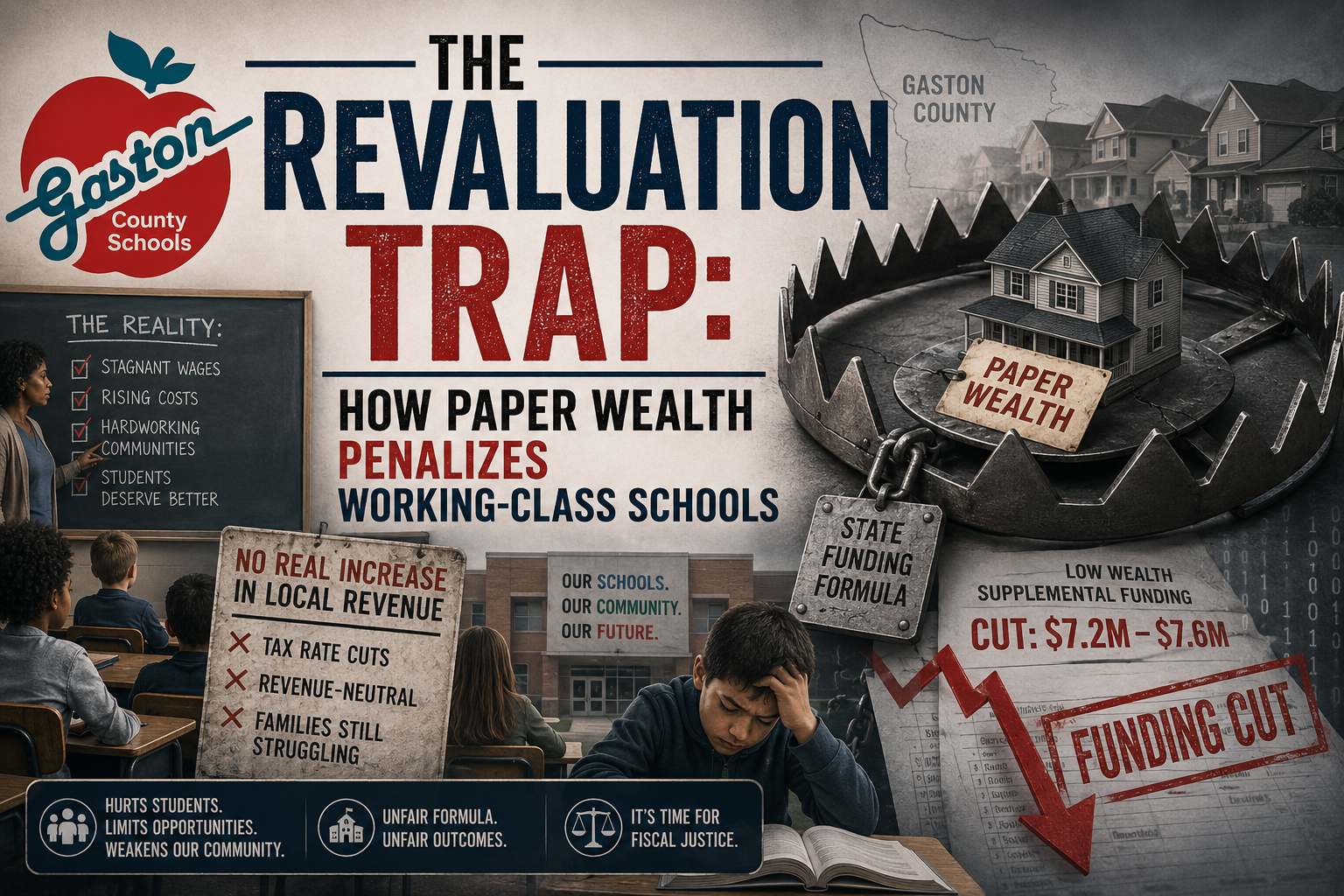
The Revaluation Trap: How Paper Wealth Penalizes Working-Class Schools
The Focus: The state formula that punishes local communities for real estate bubbles they did not create.
What We Cover: In late 2025, a mandatory county property revaluation artificially inflated local property values. Even though Gaston County lowered its nominal tax rate, a deeply flawed state formula deemed the county “wealthier”. This triggered a sudden $7.2 million to $7.3 million state budget cut to GCS’s Low Wealth Supplemental Fund—forcing an immediate hiring freeze and leaving GCS completely dependent on a series of short-term, emergency local bailouts to prevent massive teacher layoffs.
The Progressive Action: Overhauling the state’s low-wealth calculation to prioritize actual median household income over paper real estate values, and enacting safe-harbor caps to prevent sudden, catastrophic funding drops.
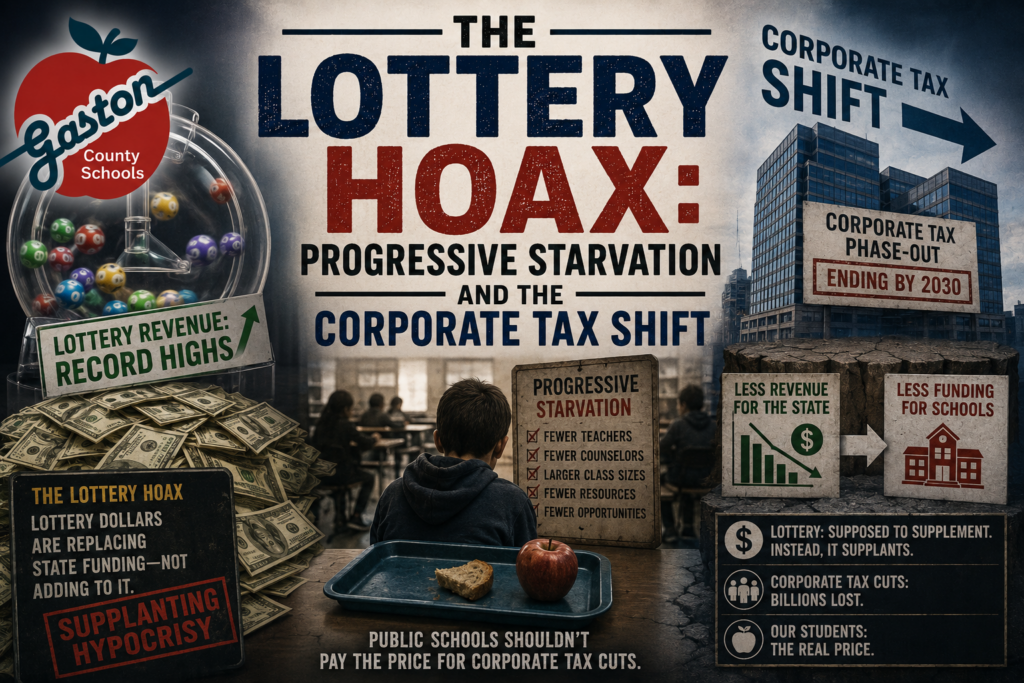
The Lottery Hoax: Progressive Starvation and the Corporate Tax Shift
The Focus: The bait-and-switch that turned a public education funding promise into a subsidy for corporate tax cuts.
What We Cover: The North Carolina Education Lottery was sold on the promise of supplementing public classrooms. However, state lawmakers have systematically used lottery revenues to supplant general fund commitments. A state audit confirmed that as lottery revenues grew by over $1 billion, the net dollars actually reaching public classrooms declined. This shell game has allowed the General Assembly to aggressively phase out corporate income taxes entirely by 2030, starving our rural and suburban public infrastructure.
The Progressive Action: Restoring corporate tax rates and establishing a strict statutory firewall that bans the state from using lottery proceeds to displace traditional General Fund education obligations.
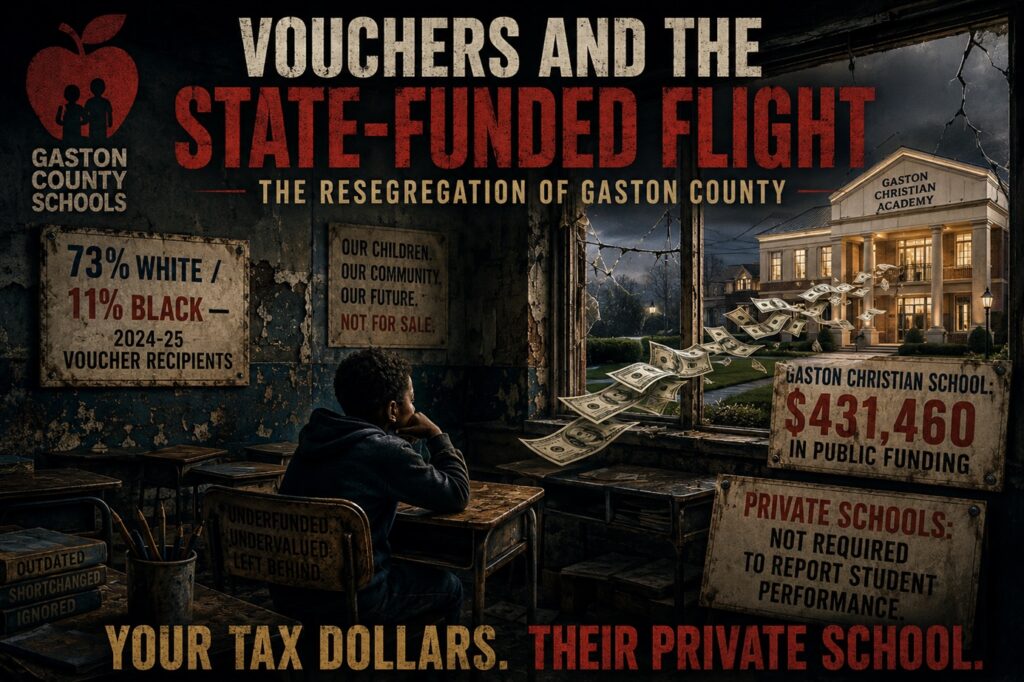
Vouchers and the State-Funded Flight: The Resegregation of Gaston County
The Focus: How private school “Opportunity Scholarships” became a regressive wealth transfer and a tool for socioeconomic segregation.
What We Cover: State data reveals that a staggering 88.5% of voucher recipients statewide never set foot in a public school; they were already enrolled in private institutions. Because the maximum voucher of $7,468 fails to cover elite private school tuition like Gaston Christian (where high school tuition is $13,478) , vouchers act as a state subsidy for wealthy families while locking out lower-income students of color. We track the millions in taxpayer funds flowing directly to private, unaccountable schools in Gastonia and Bessemer City.
The Progressive Action: Reinstating strict household income caps and public school prerequisites for voucher eligibility, and requiring any school accepting public dollars to adhere to public civil rights, non-discrimination, and academic testing standards.
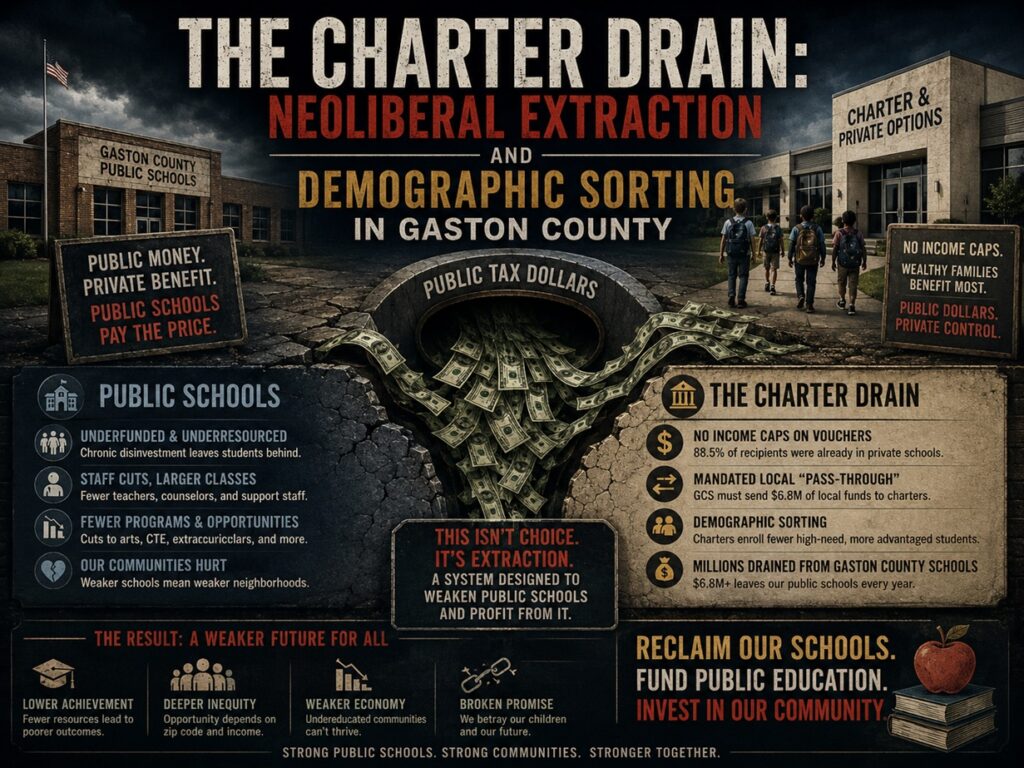
The Charter Drain: Neoliberal Extraction and Demographic Sorting
The Focus: The dual impact of local capital extraction and the resegregation of Gaston County’s student body.
What We Cover: Under North Carolina law, GCS was forced to hand over $6.8 million of its limited $54 million local operating budget directly to charter schools. This “pass-through” leaves public schools holding the bill for fixed facilities overhead on a depleted budget. Meanwhile, elite charters like Piedmont Community Charter remain disproportionately White (52.7%) compared to the diverse city of Gastonia (over 30% Black) , while struggling charters like Ridgeview Charter are closed for academic failure , dumping high-need students back onto a public system that has already been financially drained.
The Progressive Action: Eliminating the local funding pass-through in favor of direct state charter funding, and requiring charter schools to maintain strict demographic parity with the districts they serve.
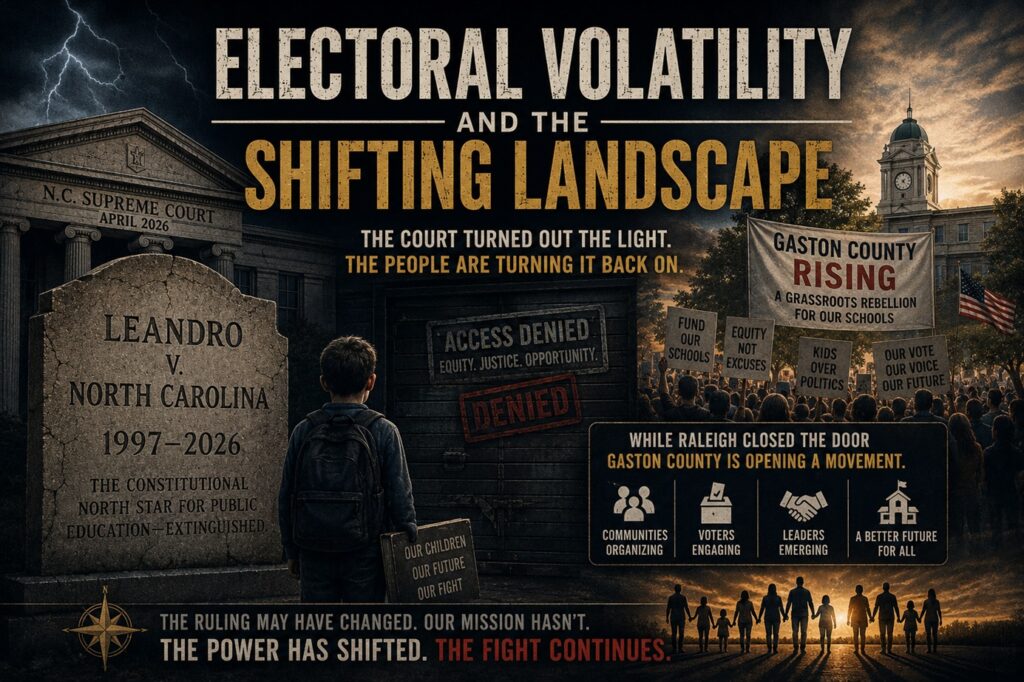
Electoral Volatility and the Shifting Landscape
The Focus: The closing of legal equity pathways and the rise of a grassroots political rebellion.
What We Cover: The conservative-majority NC Supreme Court’s April 2026 decision in Leandro V brought a sudden, partisan end to a 30-year legal battle to force the state to fund a “sound basic education”. With the courts abandoning our children, the battleground has shifted. We analyze the historic March 2026 Republican primary, where political newcomer Caroline Eason unseated 15-year incumbent Rep. Kelly Hastings—proving that local voters across the political spectrum are growing furious with public school disinvestment.
The Progressive Action: A community manifesto for grassroots organizing, building multi-racial coalitions of parents and educators, and running pro-public education candidates to take back local and state-level democratic control.
Join the Conversation
This engineered crisis was created by political choices, and it can only be solved by a community that refuses to let its public institutions be sold off to the highest bidder. Read the articles, share the data with your neighbors, and join us in demanding that our county commissioners and state representatives fund our children’s future, not corporate tax cuts.
To receive email notifications as each new article in this series is published, sign up for our newsletter below.